RepMold Explained: Meaning, Uses, Manufacturing Process, Benefits and Facts
October 6, 2026
0
RepMold sounds like the name of a specific industrial technology. Search results make that impression even stronger. Several websites describe it as an advanced mold-making system capable of
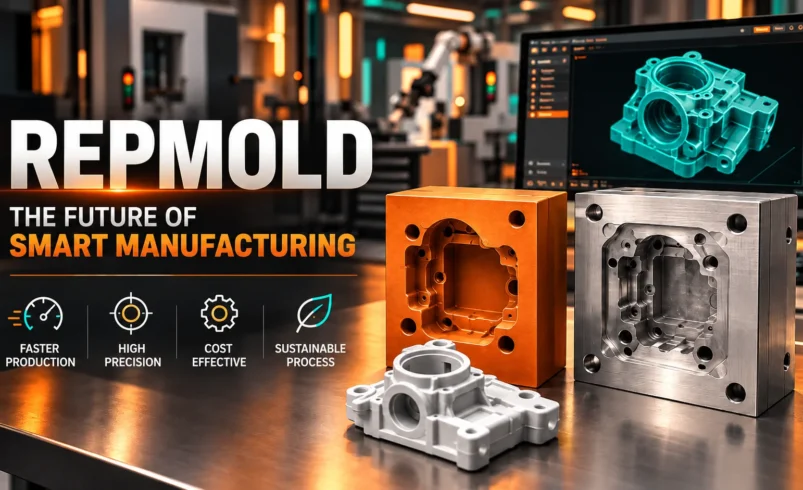
RepMold sounds like the name of a specific industrial technology. Search results make that impression even stronger. Several websites describe it as an advanced mold-making system capable of reproducing components faster, repairing damaged tooling, cutting costs and combining 3D scanning, CAD, CNC machining and additive manufacturing into one modern workflow.
The problem is that the word itself is much less established than the technologies attached to it.
There is no clear evidence that RepMold is a formally standardized manufacturing process, internationally recognized engineering term or single proprietary machine. Instead, the term appears online in several overlapping ways. It is the name of Repmold.com, a broad publishing website that accepts guest articles. It is also increasingly used by online publishers as an informal label for mold replication, digital mold making, reverse engineering, rapid tooling and mold repair.
Those underlying technologies are real.
NIST documents additive manufacturing as an established field and specifically notes its use for creating molds, mold inserts and patterns. Digital design, CNC machining, 3D scanning and rapid tooling are also widely used across modern manufacturing.
What remains unclear is whether “RepMold” itself should be treated as an official name for that collection of methods.
That distinction matters.
Understanding RepMold properly requires separating the keyword from the established manufacturing processes surrounding it.
What Is RepMold?
The most accurate current definition is:
RepMold is an emerging and informal online term associated with mold replication, mold development, repair, rapid tooling, reverse engineering and digitally assisted manufacturing. It is not currently established as one universally defined industrial process.
Different websites use the word differently.
Repmold.com describes RepMold in one article as an advanced mold-making technology designed to create accurate copies of components more quickly than traditional methods.
Other publications take a more cautious approach.
Novexa Magazine describes RepMold as an informal term connected with mold replication, rapid tooling, reverse engineering, 3D scanning and CAD rather than one clearly defined machine or manufacturing process.
That second interpretation fits the available evidence more closely.
RepMold Quick Facts
Question
Best-supported answer
Is RepMold a standard English word?
No widely established dictionary entry
Is RepMold a standardized manufacturing process?
Not clearly established
Is it connected with mold making?
Yes, in current online usage
Is RepMold.com a website?
Yes
Is Repmold.com a manufacturing company?
Not established by its public About page
Does RepMold involve 3D printing?
It may describe workflows that use it
Does it involve CAD?
Often, in the way current articles define it
Does it involve CNC machining?
Potentially
Is it the same as rapid tooling?
No
Is it the same as remold?
No
Is it a patented machine?
No clear evidence establishes that
Is it an ISO/ASTM standard?
No evidence found that RepMold itself is one
The key is that the associated technologies are real even when the label remains informal.
Where Did the Term RepMold Come From?
The exact origin is unclear.
Several websites suggest that the first part of the word, “Rep,” could mean:
replication;
reproduction;
repair;
repeated production;
rapid replication.
The second half obviously resembles “mold.”
That makes “replication mold” or “repair and replicate mold” sound plausible.
Creative Business Spot, for example, interprets RepMold as shorthand for “repair and replicate mold.”
Other sites associate it more broadly with digital mold replication.
However, no authoritative technical body appears to have published an official etymology for the term.
So statements such as “RepMold stands for repair and replicate mold” should be treated as interpretations rather than fixed industry definitions.
Is RepMold a Real Manufacturing Technology?
This question needs a careful answer.
The processes described under the RepMold label are real.
The label itself is not yet established as a standardized manufacturing technology.
For example, NIST documents additive manufacturing methods including:
powder bed fusion;
directed energy deposition;
material extrusion;
vat photopolymerization;
binder jetting;
material jetting.
NIST also explains that additive manufacturing can produce:
molds;
mold inserts;
casting patterns;
customized tooling;
low-volume parts;
replacement components.
Those are recognized technical applications.
But NIST’s additive-manufacturing standards pages discuss ISO and ASTM standards without identifying a formal “RepMold” process among them.
That means it is more accurate to say:
RepMold is a convenient modern label being used for combinations of established manufacturing techniques rather than a newly proven industrial process with one official specification.
Is RepMold the Same as Remold?
No.
This is one of the biggest semantic gaps in current search results.
Remold is an established English word.
It means to mold or shape something again.
Webster’s historical dictionary defines remold as “to mold or shape anew.”
mold replication = copying a mold or part geometry;
rapid tooling = fast production of tooling such as molds, dies or patterns.
These should not be treated as interchangeable.
Is RepMold the Same as Rapid Tooling?
No, although there is overlap.
Rapid tooling is already an established manufacturing concept.
Formlabs defines rapid tooling as techniques used to make tooling quickly and economically, particularly for shorter timelines or lower production volumes. The tooling may include molds, dies and patterns used to produce final components.
RepMold articles often describe very similar goals:
shorten mold-production time;
reduce tooling costs;
produce prototypes;
make replacement molds;
recreate old components;
modify existing tooling.
That makes rapid tooling one of the closest established concepts to what many writers mean by RepMold.
But it is still inaccurate to say they are exactly the same term.
Is RepMold the Same as Additive Manufacturing?
No.
Additive manufacturing is an established technical field.
NIST defines additive manufacturing as the fabrication of three-dimensional products by building material layer by layer from a digital design.
RepMold may use additive manufacturing as one step.
For example:
An existing part is scanned.
A CAD model is created.
Mold geometry is designed.
The mold or mold insert is 3D printed.
The tool is finished.
Production begins.
In that workflow, 3D printing is the manufacturing method used to create the tool.
RepMold would simply be the broader informal label placed around the project.
How a RepMold-Style Workflow Could Work
Although no universal RepMold specification exists, many articles describe similar workflows.
A practical RepMold-style process might look like this.
Step 1: Start With a Part, Mold or Digital Design
The project needs a starting reference.
That could be:
an original physical component;
a worn mold;
an old replacement part;
a prototype;
an existing CAD file;
a new product design.
The starting point determines the next step.
Step 2: Capture the Geometry
If only a physical object exists, engineers may need to digitize it.
This can involve:
3D scanning;
coordinate measuring machines;
structured-light scanning;
laser scanning;
manual measurement.
The goal is to create enough geometric information to reproduce the part accurately.
Step 3: Build or Repair the CAD Model
The scan usually cannot simply be sent directly into production.
Engineers may need to:
repair missing surfaces;
remove scanning noise;
rebuild damaged geometry;
compensate for shrinkage;
add draft angles;
design parting lines;
create gates and runners;
modify wall thickness;
account for tooling constraints.
This is where engineering judgment becomes critical.
A digital copy is not automatically a manufacturable mold.
Step 4: Create the Mold Design
The part geometry is converted into negative mold geometry.
Depending on the molding process, the design may include:
core and cavity;
ejector features;
cooling channels;
gates;
runners;
vents;
inserts;
alignment features;
draft.
The exact design depends on the material being molded and the production process.
Step 5: Select the Tooling Method
A mold can be produced in several ways.
Possible options include:
CNC-machined aluminum;
CNC-machined steel;
resin 3D printing;
metal additive manufacturing;
cast tooling;
hybrid tooling;
printed inserts.
The right choice depends heavily on production volume and performance requirements.
Step 6: Manufacture the Mold
This is where the physical tool is created.
For very low-volume work, an additive process may be suitable.
For long-run industrial injection molding, machined metal tooling may still be preferred.
NIST notes that additive manufacturing can reduce the number of process steps when producing molds, mold inserts and patterns.
That benefit is one reason digital tooling has attracted so much attention.
Step 7: Finish the Tool
A manufactured mold may still require:
polishing;
heat treatment;
machining;
surface coating;
dimensional inspection;
sealing;
installation of inserts.
The exact finishing process depends on the manufacturing method.
Step 8: Test the Mold
A tool should be validated before full production.
Testing may involve checking:
dimensional accuracy;
filling behavior;
surface quality;
warpage;
shrinkage;
cycle time;
defects;
tool wear.
Iteration may then be required.
Reverse Engineering and RepMold
One of the strongest possible use cases for a RepMold-style workflow is reverse engineering.
Imagine a manufacturer operating a machine built thirty years ago.
A plastic component breaks.
The original supplier no longer exists.
No CAD file is available.
Only the damaged component remains.
A modern reverse-engineering workflow could involve:
scanning the original;
reconstructing missing geometry;
designing a mold;
producing tooling;
manufacturing replacements.
That is a real and valuable manufacturing scenario.
Calling that workflow “RepMold” may be convenient, but the important technologies are reverse engineering, digital design and tooling.
RepMold and Mold Repair
Another common interpretation relates to mold repair.
Industrial molds can experience:
erosion;
cracks;
worn edges;
damaged cavities;
surface defects;
corrosion;
cooling-channel problems.
Instead of manufacturing an entirely new tool, engineers may repair specific sections.
Digital scanning can help compare the worn mold against its original geometry.
Depending on the tool and damage, repair methods may involve:
welding;
machining;
metal deposition;
replacement inserts;
surface finishing.
Some RepMold articles group these repair methods together under one label.
Again, the individual repair techniques are real.
The RepMold name itself remains informal.
Could 3D Printing Replace Traditional Mold Making?
Sometimes, but not universally.
Additive manufacturing is particularly attractive when:
production volume is low;
lead time is short;
geometry is complex;
frequent iterations are expected;
prototype tooling is needed.
NIST specifically highlights improved economics for low-volume production and rapid iteration as important benefits of additive manufacturing.
But conventional tooling remains extremely important.
High-volume production may still justify hardened steel molds because of:
durability;
thermal performance;
repeatability;
long tool life;
predictable cycle times.
A printed tool that works perfectly for 100 parts might be a poor choice for one million parts.
RepMold and CNC Machining
CNC machining remains central to modern mold production.
Even when additive manufacturing is involved, machining may still be needed to produce:
precision surfaces;
sealing areas;
bores;
mating faces;
complex cavities;
tolerance-critical features.
A hybrid process can combine both.
For example, engineers might 3D print a metal insert containing complex cooling channels and then machine critical surfaces afterward.
This allows additive and subtractive manufacturing to complement rather than replace one another.
RepMold and CAD
CAD sits at the center of almost every digital manufacturing workflow associated with RepMold.
Computer-aided design allows engineers to:
rebuild a scanned part;
modify geometry;
design mold cavities;
apply tolerances;
create tooling features;
prepare manufacturing files.
Without a reliable digital model, the rest of the process becomes much harder.
That is why RepMold should not be understood as simply “3D printing a mold.”
The engineering work begins earlier.
RepMold and 3D Scanning
3D scanning becomes especially useful when the original design file no longer exists.
It can capture the shape of:
legacy parts;
handmade components;
damaged molds;
prototypes;
sculpted objects.
The scan becomes a digital reference.
But scans need interpretation.
If a part is worn, simply copying every defect would recreate the damage.
An engineer may need to determine what the original geometry should have been.
That is why reverse engineering remains a skilled technical process.
Industries Where RepMold-Style Workflows May Be Useful
Because the term describes a flexible digital approach rather than one machine, potential applications are broad.
Automotive
Possible uses include:
prototype trim;
replacement parts;
custom components;
obsolete parts;
low-volume molds.
NIST notes that additive manufacturing is useful for rare or classic automotive spare parts.
Aerospace
Aerospace manufacturers use digital manufacturing extensively because components can be complex and production volumes may be lower than in consumer manufacturing.
Tooling must still meet strict quality requirements.
Medical
Custom manufacturing can be useful for:
prosthetic components;
fixtures;
device development;
prototypes.
NIST lists customized medical and surgical applications among additive-manufacturing use cases.
Consumer Products
Companies developing:
housings;
handles;
caps;
enclosures;
accessories;
may use rapid tooling to test products before investing in expensive mass-production molds.
Industrial Maintenance
Factories with aging equipment may need replacement parts that are no longer commercially available.
Reverse engineering and small-batch manufacturing can help address these situations.
Main Benefits Associated With RepMold
The strongest benefits come from the underlying digital manufacturing technologies.
Faster Development
Digital workflows can reduce the time between design and physical tooling.
This becomes particularly valuable when multiple iterations are needed.
Lower Cost for Low Volumes
Traditional tooling can be expensive.
For very small production runs, the cost per tool may dominate the project.
NIST notes that additive manufacturing can improve economics for low-volume production by avoiding traditional tooling costs.
Easier Design Changes
A digital design can be modified without completely restarting every stage.
That makes experimentation easier.
Replacement of Obsolete Components
A physical sample may be reverse engineered even if the original drawings are gone.
Reduced Material Waste
Additive manufacturing builds material rather than removing large amounts from a block.
NIST notes that this can reduce waste compared with some traditional subtractive methods.
Customization
Different versions of a component can be produced without committing immediately to permanent tooling.
Limitations of RepMold-Style Manufacturing
Current ranking pages often emphasize speed and innovation while underplaying the engineering limits.
That is one of the biggest content gaps.
Accuracy Depends on Every Step
A scanning error can become a CAD error.
A CAD error can become a tooling error.
A tooling error can affect every molded part.
Digital workflows do not eliminate quality control.
Surface Finish Can Require Extra Work
Some additive processes create visible layer lines or rougher surfaces.
Finishing may be necessary.
Tool Life Can Be Limited
Some printed polymer molds are appropriate only for short production runs.
They may not survive the heat and pressure of large-scale injection molding.
Materials Matter
Not every tooling material works with every molding material.
Temperature, pressure, chemistry and wear all matter.
Cost Is Not Always Lower
A digitally produced tool can still be expensive if:
tolerances are tight;
metal printing is required;
extensive machining follows;
inspection requirements are high.
Skilled Engineers Are Still Required
Software does not replace manufacturing knowledge.
Designers must understand:
draft;
shrinkage;
gating;
cooling;
tolerances;
material behavior.
Is RepMold More Accurate Than Traditional Mold Making?
Not automatically.
Digital tools can improve repeatability and measurement.
But traditional CNC machining can also deliver extremely high precision.
Accuracy depends on:
machine quality;
calibration;
scanning precision;
material;
thermal behavior;
finishing;
inspection.
RepMold should therefore not be marketed as inherently “more accurate” than every conventional method.
A better statement is that digital techniques can make certain mold-development and replication tasks more efficient.
Is RepMold Cheaper?
Sometimes.
The biggest potential cost advantage appears in:
prototypes;
one-off tools;
low-volume production;
iterative development;
replacement components.
For high-volume manufacturing, conventional tooling may offer lower total cost over the life of the product.
The correct comparison should examine total project cost, not just mold-manufacturing cost.
Is RepMold Faster?
It can be.
Rapid tooling and additive manufacturing are specifically designed to reduce development time in suitable applications.
Formlabs notes that rapid tooling allows manufacturers to create tooling faster and validate designs before committing to mass production.
Still, speed depends on project complexity.
A high-precision metal injection mold may require significant finishing and validation even if additive manufacturing shortens one stage.
Is RepMold Sustainable?
This is more complicated than simply saying yes.
Potential sustainability advantages include:
lower material waste;
fewer physical prototypes;
localized production;
on-demand replacement parts;
longer life for equipment through repair.
NIST notes that additive manufacturing can reduce material waste and inventory requirements in some applications.
However, sustainability also depends on:
energy consumption;
material production;
post-processing;
machine efficiency;
disposal;
production scale.
No manufacturing method is environmentally superior in every situation.
What Is Repmold.com?
This is another major source of confusion.
Repmold.com is an active website.
Its About page describes Repmold as a community for writers that aims to publish useful content across a wide range of topics.
It explicitly invites people interested in areas such as:
technology;
fashion;
lifestyle;
to contribute guest posts.
That description does not resemble the About page of an industrial mold manufacturer.
Is Repmold.com a Manufacturing Company?
Based on its public About page, there is not enough evidence to describe it as a manufacturing company.
The website describes itself as a publishing community.
It accepts guest posts and publishes articles across multiple subjects.
Interestingly, the same website also hosts an article titled “Boost Efficiency with Repmold Innovation”, which describes Repmold as an advanced mold-making technology.
That creates a clear distinction:
The website publishes content about a concept called RepMold, but that does not prove the website operates factories or sells industrial tooling.
Who Owns Repmold.com?
The public About page does not provide enough information to confidently identify a registered corporate owner.
It does list a contact email.
But an email address is not equivalent to:
incorporated company details;
named executive leadership;
registered office;
manufacturing facility;
industrial certifications.
Those details should not be invented.
Does Repmold.com Accept Guest Posts?
Yes.
Its About page explicitly says the site welcomes writers and directs users toward a guest-post submission process.
This helps explain the wide range of topics appearing on the domain.
Why Are So Many RepMold Articles Similar?
The search results show a clear pattern.
Many articles now describe RepMold using very similar themes:
digital mold making;
replication;
CAD;
reverse engineering;
3D printing;
CNC;
speed;
lower cost;
sustainability.
That does not necessarily mean the term originated as a formal manufacturing standard.
A more likely explanation is that online usage is gradually converging around a shared interpretation.
Once several websites describe a new term similarly, later writers may repeat the framework.
Over time, that can make an informal label look more established than it actually is.
Common Misconceptions About RepMold
“RepMold is an ISO manufacturing standard”
No evidence reviewed here establishes that.
“RepMold is a patented machine”
No clear evidence establishes one universal RepMold machine.
“RepMold is a specific type of 3D printer”
It is not.
“RepMold replaces injection molding”
No. It may describe ways of producing tooling used in injection molding.
“RepMold is the same as rapid tooling”
They overlap conceptually, but rapid tooling is an established term with a clearer definition.
“RepMold.com manufactures molds”
The site’s public About page describes a publishing community rather than an industrial manufacturer.
“RepMold always lowers cost”
Cost depends on volume, materials, tolerances and production requirements.
“RepMold means remold”
No. Remold is an established English word meaning to shape again.
How to Evaluate a Company Claiming to Offer RepMold Services
If a manufacturer uses the RepMold name commercially, focus on measurable capabilities rather than the label.
Ask:
What manufacturing process is actually being used?
What materials are supported?
What tolerances can be guaranteed?
What mold life is expected?
Is tooling printed, machined or both?
What inspection methods are used?
Can the company provide sample parts?
What production volumes are realistic?
Are quality certifications available?
These answers matter far more than whether the company calls its workflow RepMold.
RepMold vs Traditional Tooling
The difference is best understood as digital flexibility versus conventional production maturity.
Traditional tooling
Often relies heavily on:
CNC machining;
EDM;
steel;
aluminum;
established mold-design practices.
Advantages may include:
long tool life;
predictable performance;
production-scale durability.
RepMold-style digital tooling
May emphasize:
scanning;
digital reconstruction;
additive manufacturing;
rapid iteration;
low-volume tooling.
Potential advantages include:
speed;
flexibility;
easier replication;
lower cost for small batches.
The right choice depends on the project.
RepMold vs Injection Molding
Injection molding is a production process.
RepMold is better understood as a possible tooling-development concept.
Injection molding works by injecting molten material into a mold cavity.
A RepMold-style workflow might be used to create that mold.
Therefore, the two can work together.
They are not competing processes.
RepMold vs 3D Printing
3D printing produces physical objects directly from digital designs.
RepMold may use 3D printing to produce:
molds;
inserts;
patterns;
prototypes.
But RepMold can also involve CNC machining and other processes.
So 3D printing is better viewed as one possible tool within the workflow.
RepMold vs Reverse Engineering
Reverse engineering focuses on understanding and recreating an existing product or system.
RepMold may use reverse engineering when an existing part needs to be copied.
But a RepMold-style project can also begin from a brand-new CAD design.
Therefore, reverse engineering is one possible component, not the entire concept.
Is RepMold the Future of Manufacturing?
The underlying technologies certainly have major industrial importance.
NIST continues to develop standards and measurement science around additive manufacturing, and recognized industrial committees such as ASTM F42 and ISO/TC 261 are actively involved in additive-manufacturing standards.
Digital manufacturing will likely continue expanding.
But saying “RepMold is the future of manufacturing” would overstate the evidence.
A better conclusion is:
Digital tooling, additive manufacturing, scanning and rapid tooling are important parts of manufacturing’s future. RepMold may continue developing as an informal umbrella term for some of those workflows.
Frequently Asked Questions About RepMold
What is RepMold?
RepMold is an emerging online term associated with mold replication, rapid tooling, reverse engineering and digitally assisted mold making. It does not currently have one standardized technical definition.
Is RepMold a real technology?
The manufacturing techniques associated with it are real, but RepMold itself is not clearly established as a formal standardized process.
Is RepMold the same as remold?
No. Remold is an established English word meaning to mold or shape again.
Is RepMold a company?
Repmold.com exists as a website, but its About page describes a content and guest-post community rather than a manufacturing company.
Does RepMold use 3D printing?
It can. Current articles often use the term for workflows involving 3D printing, scanning, CAD and CNC machining.
Is RepMold the same as rapid tooling?
No. Rapid tooling is a recognized manufacturing concept involving fast creation of tooling such as molds, dies and patterns.
Can RepMold be used for injection molding?
A RepMold-style workflow could be used to develop tooling or mold inserts for injection molding.
Can RepMold repair old molds?
Some online definitions include mold repair, scanning and digital reconstruction as possible uses.
Is RepMold suitable for mass production?
It depends on the actual tooling material and manufacturing process. Short-run printed tooling and long-life steel molds have very different capabilities.
Is RepMold cheaper than normal mold making?
It can be cheaper for low-volume production or prototypes, but it is not guaranteed to cost less in every application.
Is RepMold patented?
No universal RepMold patent or proprietary system was established through the authoritative manufacturing sources reviewed here.
Does NIST recognize RepMold?
NIST documents additive manufacturing and the use of AM for molds and mold inserts, but RepMold itself does not appear as a named standardized process in the NIST material reviewed.
Final Thoughts
RepMold is a good example of how internet terminology can develop faster than formal technical language.
Search results increasingly describe RepMold as a modern approach to mold replication, repair and digital tooling. Many of the technologies attached to that description are absolutely real: 3D scanning, CAD, CNC machining, reverse engineering, additive manufacturing and rapid tooling all have established roles in modern production.
NIST specifically confirms that additive manufacturing can be used for molds, mold inserts and patterns and can reduce tooling-related cost and lead time in appropriate low-volume applications.
What remains uncertain is the RepMold name itself.
There is currently no strong evidence that RepMold represents one formally standardized manufacturing technology, universally recognized engineering method or single industrial platform.
The same caution applies to Repmold.com.
Its own About page presents the site as a broad publishing community that accepts guest contributions, while one of its articles describes RepMold as advanced manufacturing technology.
That difference should not be ignored.
The most accurate way to understand RepMold in 2026 is therefore as an emerging informal label for digitally assisted mold replication, development, repair and tooling workflows.
For engineers and manufacturers, the name matters less than the actual process underneath it.
A serious project should always be evaluated in terms of material, tooling life, tolerance, production volume, manufacturing method and inspection requirements.
If RepMold eventually develops into a formal commercial platform or recognized technical standard, its definition may become much narrower.