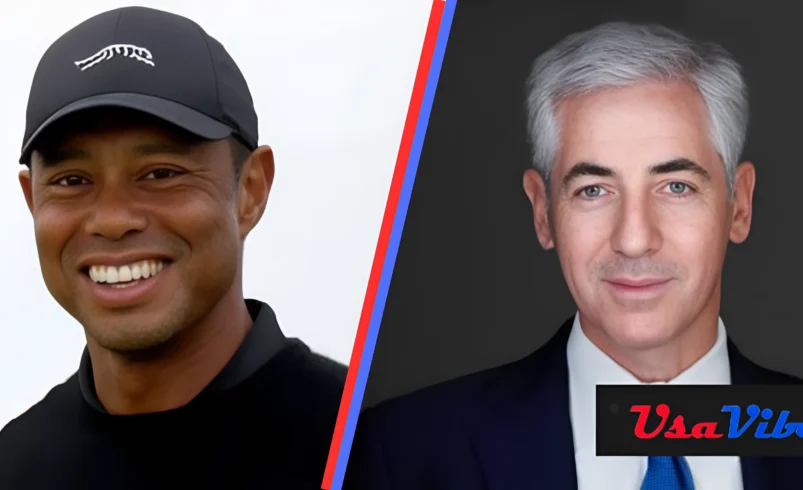
Tiger Woods and Bill Ackman: Their Nike Connection Explained
October 17, 2026
0
The connection between Tiger Woods and Bill Ackman is rooted in the business world rather than a publicly established personal relationship. Woods became one of the most recognizable
The connection between Tiger Woods and Bill Ackman is rooted in the business world rather than a publicly established personal relationship. Woods became one of the most recognizable athletes associated with Nike, while Ackman, the billionaire investor behind Pershing Square Capital Management, made substantial investments in the sportswear company.
Their histories with Nike unfolded at different times. Woods ended his celebrated 27-year partnership with the brand in January 2024. Later that year, Ackman’s investment firm disclosed a new position in Nike shares as the company faced growing pressure to revive its business.
The investment story also changed significantly afterward. Pershing Square increased its exposure, converted its Nike shares into options in early 2025, and eventually exited the investment that November. Its own reporting subsequently confirmed the exit.
These facts offer a meaningful explanation for why the two names appear together in online searches. However, they do not establish that Woods and Ackman were business partners, jointly financed a project, or collaborated on Nike’s corporate strategy.
Understanding their connection requires separating three different relationships: an athlete’s endorsement of a brand, an investment firm’s ownership of that company’s stock, and any direct professional relationship between the individuals involved.
Who Are Tiger Woods and Bill Ackman?
Tiger Woods: Golf Champion and Business Entrepreneur
Tiger Woods is an American professional golfer whose career reshaped the commercial and competitive landscape of modern golf.
After turning professional in 1996, Woods quickly became a dominant figure. He won the Masters in 1997 and went on to accumulate 15 major championships and 82 PGA Tour victories. His PGA Tour win total ties the all-time record.
His influence extends beyond tournament results. Woods became a major figure in sports marketing, helping demonstrate how a world-class athlete could build a recognizable commercial identity beyond competition.
Nike was central to that story. For more than two decades, Woods appeared in the company’s apparel, advertising campaigns, and golf-related marketing.
He also expanded into business activities under the TGR umbrella, including golf-course design, events, and other ventures. His involvement in TMRW Sports and TGL, the technology-driven golf league developed with Rory McIlroy and Mike McCarley, illustrates how his professional interests have evolved.
Woods’ career combines athletic achievement, endorsement value, entrepreneurship, and a global public profile.
Bill Ackman: Investor and Founder of Pershing Square
Bill Ackman is an American investor known for establishing Pershing Square Capital Management in 2004.
His investment approach emphasizes identifying businesses that he believes are undervalued or capable of improving their long-term performance.
Ackman became particularly well known for activist investing, a strategy in which an investor acquires an ownership stake and may push for changes in corporate management, strategy, or governance.
His investment history includes major positions in businesses across industries such as restaurants, transportation, hospitality, and consumer products.
Over time, Pershing Square has also emphasized concentrated ownership of companies it considers high quality, with the potential for sustainable cash generation and long-term value creation.
Ackman’s association with Nike comes from his firm’s investments in the publicly traded company, not from a sports endorsement agreement.
That distinction is the foundation of the Tiger Woods and Bill Ackman story.
What Is the Actual Connection Between Tiger Woods and Bill Ackman?
The clearest documented link between the two men is Nike.
For Woods, Nike was a long-term sponsor and commercial partner. The relationship began when he turned professional in 1996 and continued until January 2024.
For Ackman, Nike represented an investment opportunity. Pershing Square held Nike shares in an earlier investment that it exited in 2018, then returned to the company in 2024.
Although their careers intersected through the same corporation, the two relationships had different purposes.
Woods contributed to Nike’s brand recognition through his athletic achievements, public image, and association with golf. Ackman’s firm sought financial returns from its investment in the company.
An important detail is that Ackman’s 2024 Nike investment was disclosed after Woods had already ended his endorsement relationship.
Their Nike connections therefore should not be described as a joint venture or evidence of direct collaboration.
There is also no well-established public documentation identifying the two men as close personal friends, relatives, or formal business partners.
The available evidence supports an indirect corporate connection rather than a personal or contractual partnership.
Tiger Woods’ Historic Partnership With Nike
How the Relationship Began in 1996
Nike’s association with Woods began during one of the most consequential transitions in his career.
In 1996, Woods moved from amateur competition into professional golf. Nike recognized his exceptional sporting potential and introduced him to a broader commercial audience through a high-profile marketing relationship.
The partnership helped connect Nike’s image with a rising figure whose appeal reached beyond traditional golf audiences.
Woods’ early success made the relationship especially valuable.
His first Masters victory in 1997 established him as an extraordinary competitive talent. His subsequent performances contributed to sustained public attention and cemented his status as one of the world’s leading athletes.
For Nike, an association with Woods offered something more durable than a conventional advertising campaign: a long-running connection with an athlete who repeatedly appeared in major sporting moments.
Why Woods Was Important to Nike’s Brand
Sports endorsements are based partly on visibility, but their broader commercial value comes from the associations consumers develop with an athlete.
Woods represented performance, competitive excellence, determination, and an instantly recognizable presence in professional golf.
His relationship with Nike became an example of how an athlete could help define a brand’s identity within a particular sport.
The commercial connection operated across several areas. Nike promoted golf clothing and footwear associated with Woods, featured him in advertising, and benefited from his visibility at major events.
However, brand visibility should not be confused with a directly measurable increase in sales. Although Woods’ importance to Nike’s marketing is well documented, isolating his precise financial contribution from other factors would require detailed evidence.
Why Tiger Woods and Nike Separated
On January 8, 2024, Woods confirmed that his partnership with Nike had ended after 27 years.
The announcement closed one of the most recognizable athlete-brand relationships in professional sports.
Both sides publicly expressed appreciation for the partnership.
Nike had already undergone important changes in its golf business, including its decision to leave the golf-equipment category in 2016. Woods’ later footwear choices and the company’s changing commercial priorities attracted attention before the separation.
Nevertheless, the public announcement did not establish one definitive reason for the split. It would be inaccurate to attribute the decision solely to financial disagreements, Woods’ age, or Nike’s business performance without direct evidence.
What is certain is the timing. By the time Pershing Square disclosed its new Nike investment in August 2024, Woods’ formal relationship with Nike had ended.
Bill Ackman’s Nike Investment: What Actually Happened?
Ackman’s involvement with Nike provides the second half of the connection.
Unlike Woods, whose association was built through sponsorship and sports marketing, Ackman’s exposure to Nike came through the financial markets.
His firm’s investment history is particularly relevant because it includes two separate periods of Nike ownership and a significant change in strategy during 2025.
The Earlier Nike Investment
Pershing Square first invested in Nike in late 2017.
The firm subsequently exited that position in 2018, with Reuters reporting a profit of approximately $100 million.
That earlier investment matters because it establishes that Ackman’s interest in Nike did not begin in 2024.
It also demonstrates an important characteristic of professional investing: an investment manager can return to a company years after selling an earlier stake if circumstances change.
A familiar brand does not automatically represent an attractive investment at every price. Investors also evaluate expected earnings, competitive strength, valuation, management decisions, and the risks associated with future performance.
Pershing Square Returned to Nike in 2024
In August 2024, regulatory filings revealed that Pershing Square had acquired approximately three million Nike shares during the second quarter.
The holding represented roughly 0.19% of Nike at the June 30 reporting date.
The disclosure attracted attention because Nike was facing difficulties involving sales growth, competitive pressure, and questions about its business strategy.
Some market observers interpreted Ackman’s return as a possible sign that an experienced investor saw an opportunity for improvement.
However, a public investment disclosure does not necessarily reveal an investor’s complete strategy.
It establishes ownership of a reported position at a specified date, not every discussion, future intention, or potential management initiative.
Ackman’s earlier reputation for activist investing also prompted speculation that he might seek changes at Nike. Such speculation should not be presented as evidence of a specific intervention.
Why Nike Attracted Investor Attention
The Nike investment came during a challenging period for the company.
Nike faced stronger competition in important footwear categories, changes in consumer preferences, and difficulties associated with its distribution strategy.
These issues raised questions about how effectively the brand could translate its historic strength into future growth.
For an investor, this type of situation can present both opportunity and risk.
If a company successfully addresses its challenges, an investor who purchased shares at an attractive valuation may benefit. If recovery takes longer than expected or the business weakens further, the investment may lose value.
The strength of a company’s brand does not eliminate these risks.
Nike’s global recognition, long-standing association with athletes, and extensive product portfolio made it a company worth analyzing. None of those advantages guaranteed an investment recovery.
What Happened to the Nike Position in 2025?
The Nike investment underwent several important changes.
In February 2025, Pershing Square explained that it had converted its common-stock position into deep-in-the-money call options.
A call option is a financial contract that provides the right to buy an underlying asset at a predetermined price under specified conditions.
In this case, the structure allowed Pershing Square to maintain economic exposure to Nike while releasing capital for other investments.
The firm also explained that these over-the-counter derivatives would not appear in the same way as ordinary shares in its Form 13F reports.
This distinction is especially important. An investor’s disappearance from a quarterly stock-holdings report does not always mean that all economic exposure to the company has ended.
Later in 2025, Pershing Square abandoned the position.
Institutional Investor reported in November 2025 that the firm had sold its remaining Nike options, realizing a cumulative investment loss of approximately 30%, representing more than $600 million.
Pershing Square’s subsequent reporting confirmed that the Nike investment was exited during 2025.
As of October 2026, the documented investment history therefore differs substantially from the position originally disclosed in August 2024.
It would be misleading to describe Ackman as continuing to hold the same Nike stake without accounting for these developments.
Timeline of the Tiger Woods, Bill Ackman, and Nike Connection
Year
Development
1996
Tiger Woods turns professional and begins his long-term Nike partnership.
1997
Woods wins his first Masters Tournament.
2017–2018
Pershing Square invests in Nike and subsequently exits with a reported profit.
January 2024
Woods announces the end of his 27-year Nike relationship.
August 2024
Pershing Square’s new Nike investment becomes public through regulatory disclosures.
Early 2025
Pershing Square converts its Nike shares into call options.
November 2025
The firm exits its remaining Nike exposure at a substantial reported loss.
2026
Pershing Square’s subsequent reporting confirms that the investment was exited in 2025.
This timeline reveals a shared corporate connection, not a shared business project.
Woods’ endorsement relationship and Ackman’s later investment activity are part of Nike’s broader commercial history, but they should be understood independently.
How Their Relationships With Nike Were Different
The most useful way to compare Tiger Woods and Bill Ackman is to examine what each contributed to, and expected from, the company.
Area
Tiger Woods
Bill Ackman
Professional background
Professional golf
Investment management
Nike relationship
Athlete endorsement and marketing
Financial investment through Pershing Square
Principal role
Brand ambassador
Investor
Primary commercial purpose
Sponsorship and brand association
Investment returns
Main period discussed
1996–2024
2017–2018 and 2024–2025
Relationship with Nike
Long-term contractual partnership
Ownership and financial exposure
Documented direct partnership with the other person
Not established
Not established
An endorsement agreement and an equity investment may involve the same company, but they operate differently.
An athlete can promote a brand without owning its shares. A financial investor can own shares without having any relationship with the athletes featured in that company’s advertising.
The distinction also explains why Nike’s investment performance should not be attributed directly to Woods’ departure.
Nike’s financial results reflect many factors, including consumer demand, product development, competition, pricing, distribution, operational costs, and management decisions.
The end of a famous endorsement may form part of the company’s broader brand history, but it is not sufficient evidence to explain its stock-market performance.
Did Bill Ackman Invest Directly in Tiger Woods?
There is no established public evidence that Bill Ackman made a direct investment in Tiger Woods or financed one of his personal businesses.
The investment identified in public reports involved Nike.
This matters because the word investment can describe several very different financial arrangements.
Buying Nike shares means acquiring an ownership interest in Nike itself. It does not mean acquiring ownership of an athlete who previously endorsed the company.
Likewise, investing in an independent sports league, athlete-owned enterprise, or golf-related property would involve separate agreements and identifiable financial interests.
Woods has participated in business ventures beyond his playing career, including TGR-related activities and TGL. But the information reviewed for this article does not establish Ackman as a financial backer of those ventures.
Without reliable documentation of such an arrangement, describing the men as investment partners would be misleading.
What Their Careers Reveal About Sports and Business
Although the direct relationship between the men is unestablished, their respective careers illustrate two important ways in which value develops around major brands.
Athletes Can Create Commercial Value Beyond Competition
Professional athletes are not merely participants in sporting events. At the highest levels, they may become globally recognizable public figures whose identities carry commercial significance.
Woods provides a prominent example.
His successes on the golf course supported a public image that brands could associate with their products. His commercial influence also continued as he developed business activities beyond tournament golf.
That does not mean every endorsement generates a measurable financial benefit or that an athlete’s popularity guarantees product sales.
It means athlete partnerships can contribute to brand recognition, customer engagement, and long-term market positioning.
Successful sports marketing depends on the relationship between the athlete, the product, and the audience rather than fame alone.
Investors Evaluate Companies Through a Different Lens
Ackman’s career illustrates the perspective of a capital allocator.
Instead of promoting a product directly to consumers, an investment manager evaluates the business that sells it.
That evaluation can include revenue, profitability, competitive positioning, leadership, long-term cash generation, and the price paid for an ownership stake.
Even a company with exceptional brand recognition can disappoint investors if its performance falls short of expectations.
Pershing Square’s Nike experience illustrates this difference particularly well.
The firm identified potential value in a globally established sportswear business, but the investment ultimately generated a substantial loss.
The outcome shows why brand strength and investment success should not be treated as interchangeable concepts.
Reputation Does Not Guarantee Financial Performance
Woods’ reputation as a champion and Nike’s longstanding recognition among sports consumers are well established.
Ackman’s reputation as a prominent investor is also widely recognized.
Yet these reputations do not, by themselves, determine future business outcomes.
Athletes can encounter injuries, changing commercial opportunities, and shifting relationships with sponsors. Investors can encounter market volatility, mistaken assumptions, and disappointing company performance.
In both fields, public prominence often creates expectations that cannot always be fulfilled.
Their careers therefore provide an informative contrast between the value of a recognizable sporting identity and the financial risks involved in owning part of a major company.
Why Is Nike Central to This Story?
Nike is relevant because it connects the worlds of professional sports, advertising, and institutional investing.
Its business has historically depended on product innovation, global distribution, effective marketing, and relationships with prominent athletes.
Woods participated in one especially visible part of that system: the association between sporting excellence and branded merchandise.
Pershing Square participated in another: the ownership of a financial interest in the corporation.
These relationships can coexist within a company’s history without the participants ever working together.
The timing of the two men’s Nike involvement also matters.
Woods’ partnership was established when his professional career was beginning and continued for nearly three decades. Ackman’s later investment was made during a period when Nike was facing questions about its future commercial performance.
These were different chapters in the company’s development.
A clear understanding of that chronology prevents readers from assuming that Ackman’s investment was connected to Woods’ endorsement departure or that the two coordinated their decisions.
Are Tiger Woods and Bill Ackman Personally Connected?
No widely documented personal relationship between Woods and Ackman has been established through the sources reviewed.
That does not prove the two men have never met or interacted privately. It simply means a friendship or personal association should not be asserted without dependable evidence.
Both individuals have participated in prominent American business and public-life circles.
Both have also received attention for their connections to President Donald Trump. Woods has a publicly documented relationship with Trump, while Ackman publicly endorsed Trump during the 2024 presidential campaign.
These separate associations do not demonstrate that Woods and Ackman have a personal relationship with one another.
Shared acquaintances, overlapping professional networks, and connections to influential public figures are common among high-profile individuals.
Such circumstances can provide context, but they should not be treated as proof of a friendship, private agreement, or collaborative investment.
Common Misunderstandings About Tiger Woods and Bill Ackman
Several assumptions can arise when their names appear together.
They jointly invested in Nike. Public reporting documents Pershing Square’s investment, but it does not establish a coordinated Nike investment involving Woods.
Ackman funded Woods’ professional golf career. The known Nike-related investment does not support this claim. Woods’ athlete endorsement and Ackman’s financial investment were separate arrangements.
Their Nike relationships were active at the same time in 2024. Woods announced his departure in January, while Pershing Square’s new holding was disclosed in August, based on its June 30 position.
Ackman’s firm still holds the Nike investment originally reported in 2024. Pershing Square’s subsequent disclosures establish that it exited the position during 2025.
They must know each other because both are prominent public figures. Celebrity status and overlapping business circles are not sufficient evidence of a personal connection.
Clarifying these points provides a more useful answer than constructing an unsupported story around the two names.
Frequently Asked Questions
Are Tiger Woods and Bill Ackman business partners?
No direct business partnership between the two has been established by reliable public documentation reviewed for this article. Their best-supported connection is through their separate relationships with Nike.
What company connects Tiger Woods and Bill Ackman?
Nike is the principal documented corporate link. Woods endorsed Nike for 27 years, while Ackman’s investment firm held Nike positions during separate investment periods.
Did Bill Ackman buy Nike shares while Woods was sponsored by Nike?
Pershing Square’s earlier Nike investment in 2017–2018 occurred during Woods’ endorsement relationship. Its later investment, disclosed in August 2024, came after Woods announced that the partnership had ended.
Does Bill Ackman still own Nike stock?
Pershing Square confirmed that its Nike investment was exited in 2025. That does not establish whether Ackman has any separate personal holdings or whether a new investment could be made in the future.
Did Tiger Woods’ departure cause Nike’s investment difficulties?
There is insufficient evidence to establish that causal relationship. Nike’s business challenges involved broader competitive, operational, and market factors.
Conclusion
The connection between Tiger Woods and Bill Ackman is best understood through their separate involvement with Nike.
Woods helped define the company’s presence in professional golf through a long-running endorsement relationship that ended in January 2024. Ackman’s Pershing Square viewed Nike as an investment opportunity, returned to the company’s shares during 2024, and exited the investment in 2025 after a substantial loss.
Their stories illustrate two different dimensions of a major sportswear business: the commercial influence of a world-famous athlete and the financial decisions of a prominent investment manager.
There is no established evidence of a direct business partnership between them. The meaningful connection is Nike itself, and understanding that distinction gives readers a more accurate account than assumptions about an undisclosed personal or financial relationship.