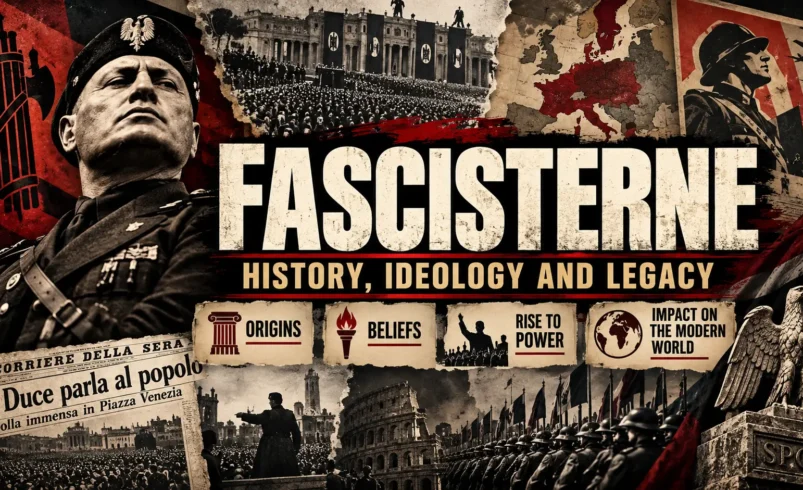
The word Fascisterne may look like the name of a political party, historical organization, or specific movement. In Danish, however, its basic meaning is much simpler.
Fascisterne means “the fascists.”
It is the definite plural form of the Danish noun fascist. Den Danske Ordbog lists the inflected forms fascisten, fascister, and fascisterne, confirming that the final form refers to a defined group of fascists rather than to an ideology called “Fascisterne.”
That grammatical distinction matters because the word can appear in discussions of very different periods and countries. In one Danish text, fascisterne might refer to Benito Mussolini’s followers in Italy. In another, it could describe fascist activists in Denmark. In contemporary writing, it may also be used as a political label, in which case the surrounding context is essential for determining exactly whom the writer is describing.
Understanding Fascisterne therefore requires more than a direct translation. It helps to understand the Danish grammar behind the word, the historical development of fascism, its relationship with Nazism, and the particular political environment in Denmark during the twentieth century.
What Does Fascisterne Mean?
The most direct English translation of Fascisterne is:
“the fascists.”
It refers to people identified as supporters or followers of fascism.
It does not literally mean “fascism.”
The Danish word for fascism as an ideology is fascisme.
This distinction is useful because English-speaking readers can easily mistake Fascisterne for the formal name of an organization.
By itself, it is not.
It is an ordinary Danish grammatical form.
Den Danske Ordbog defines fascist as a noun and records its inflection as -en, -er, -erne, producing fascisten, fascister, and fascisterne.
Fascisterne Grammar Explained Simply
Danish often expresses definiteness by adding an ending to a noun rather than placing a separate word such as “the” before it.
That is exactly what happens with Fascisterne.
Fascist
Fascist refers to one fascist.
In an English sentence, the meaning would be roughly equivalent to “a fascist,” depending on the grammatical context.
Fascisten
Fascisten means “the fascist.”
The ending marks the noun as definite.
Fascister
Fascister means “fascists.”
This is the plural form without the definite article.
Fascisterne
Fascisterne means “the fascists.”
This is the definite plural.
A simple comparison is therefore:
fascist = a fascist
fascisten = the fascist
fascister = fascists
fascisterne = the fascists
This is why Fascisterne should not automatically be interpreted as the name of a Danish party or movement.
Fascisterne vs Fascisme
These two Danish words are related, but they describe different things.
Fascisterne refers to people.
Fascisme refers to the ideology.
For example, a historian could write about what fascisterne did while separately analyzing the beliefs associated with fascisme.
Confusing the terms can change the meaning of a translation.
The difference is similar to English:
fascists = people
fascism = ideology
Where Does the Word Fascist Come From?
The history of the term ultimately connects to the Latin word fasces.
Fasces were bundles of rods, normally surrounding an axe, carried before certain Roman officials as symbols of authority and state power.
The symbol later became associated with Benito Mussolini’s political movement in Italy.
The connection between the ancient Roman symbol and modern fascism helped give the movement its name.
Danish subsequently adopted related words such as:
fascisme,
fascist,
fascistisk,
and fascisterne.
Where Did Fascism Begin?
Modern fascism is most closely associated with Italy after the First World War.
Lex, Denmark’s national encyclopedia, identifies fascism as a political movement and ideology founded by Benito Mussolini in Milan on March 23, 1919, through the organization Fasci di combattimento.
The early movement attracted, among others, war veterans and developed in a political environment marked by postwar instability, social conflict, nationalism, and fear of revolutionary movements.
Lex characterizes the early Italian fascist movement as nationalist, antidemocratic, and antisocialist, and notes that its activists used political violence while seeking influence.
Who Was Benito Mussolini?
Benito Mussolini was the central leader of Italian Fascism.
He became known by the title Il Duce, meaning “the leader.” Lex identifies him as the leader of Italian fascism, while the title Il Duce became closely associated with his rule.
Mussolini’s movement eventually developed into the Partito Nazionale Fascista, or National Fascist Party.
Lex records that the party was founded by Mussolini in 1921 and remained central to the Italian Fascist regime until Mussolini’s fall in 1943.
How Did Mussolini Come to Power?
One of the best-known events in the rise of Italian Fascism was the March on Rome in October 1922.
It is often simplified in popular retellings as a straightforward coup, but the historical process was more complicated.
Lex notes that the March on Rome itself should not simply be characterized as a coup because Mussolini was ultimately given power by the king within the framework of the existing political system. Fascists later presented the event as a revolutionary triumph.
This distinction matters when studying the rise of authoritarian movements.
Political systems do not always collapse through a single military seizure of power. Democratic institutions can also be weakened through combinations of political pressure, violence, elite decisions, legal changes, and institutional erosion.
What Did Fascism Historically Stand For?
Historians have debated the precise boundaries of fascism because different movements developed differently across countries.
However, established descriptions of Italian Fascism commonly emphasize several recurring characteristics.
Nationalism
Fascist movements placed heavy emphasis on the nation and national unity.
Individual interests were often treated as subordinate to the collective political project of the state or nation.
Opposition to Liberal Democracy
Historical fascism rejected many principles associated with pluralist liberal democracy.
Lex describes the original Italian movement as explicitly antidemocratic.
Strong Centralized Leadership
Fascist political systems placed substantial power in the hands of a central leader and governing movement.
In Italy, Mussolini’s title Il Duce symbolized that leadership model.
Political Mobilization
Fascist movements sought mass participation through rallies, youth organizations, propaganda, symbols, uniforms, and organized political groups.
Use of Violence
Political violence played an important role in the development of Italian Fascism.
Lex notes that early fascist groups used activist and violent methods while pursuing political influence.
Corporatism
The Italian regime promoted a system commonly described as corporatism.
Under this approach, economic and occupational groups were to be organized within structures supervised by the state rather than operating through unrestricted political competition between independent groups.
Lex notes that corporatism became part of the Fascist regime’s official ideology.
Fascisterne and the Fascist Party in Italy
When a Danish historical source discussing Italy uses fascisterne, it may simply mean Mussolini’s Fascists.
The political organization most directly associated with Mussolini was the Partito Nazionale Fascista, abbreviated PNF.
The party was founded in 1921 and dissolved after Mussolini’s fall in 1943. A successor Fascist organization operated in the Italian Social Republic before the final collapse of Fascist rule in 1945.
So in a Danish sentence about Italy during the 1920s or 1930s, fascisterne will often refer to members or supporters of that political system.
Are Fascism and Nazism the Same Thing?
No.
The terms are related historically, but they should not simply be treated as interchangeable.
Fascism developed first in Italy under Mussolini.
Nazism developed in Germany through Adolf Hitler and the National Socialist German Workers’ Party.
Both systems rejected liberal democratic pluralism and developed authoritarian one-party rule, but Nazism placed racial ideology and antisemitism at the center of its political worldview to an extent that distinguished it from early Italian Fascism.
The two regimes later became political and military allies.
Lex notes that the Rome-Berlin Axis was proclaimed in 1936 and describes ideological connections between Nazi Germany and Fascist Italy as part of the background to their cooperation.
Fascisterne vs Nazisterne
Danish makes a useful linguistic distinction here.
Fascisterne = the fascists
Nazisterne = the Nazis
Den Danske Ordbog defines nazist as a supporter of Nazism and records the corresponding forms nazisten, nazister, and nazisterne.
The words may overlap in some historical discussions, but they are not automatically synonyms.
A Nazi can be discussed within the broader history of fascist politics, but historically specific writing should distinguish Italian Fascism, German National Socialism, and other movements rather than collapsing them into one category without explanation.
Fascism in Denmark
Fascism and Nazism never achieved the same level of political dominance in Denmark that they did in Italy or Germany.
Denmark nevertheless experienced its own authoritarian and far-right movements during the interwar years.
Danish political life in the 1930s was influenced by events elsewhere in Europe, particularly the rise of Mussolini and Hitler.
Danmarkshistorien notes that authoritarian currents inspired by fascism and Nazism appeared on the Danish right during this period, although they did not overturn Denmark’s broader parliamentary political order.
What Was DNSAP?
The Danmarks Nationalsocialistiske Arbejderparti, normally abbreviated DNSAP, was Denmark’s principal Nazi party.
It should be described specifically as a National Socialist or Nazi party rather than simply assuming that every reference to Danish fascisterne points to DNSAP.
However, DNSAP is central to understanding Danish far-right politics during the era.
The party existed during the 1930s and the Second World War and drew ideological inspiration from Hitler’s movement in Germany.
Danmarkshistorien notes that DNSAP was strengthened politically by Hitler’s rise to power in Germany in 1933 and advocated more authoritarian responses to the economic and political problems of the period.
Did Fascism Become Popular in Denmark?
Authoritarian movements existed in Denmark, but they remained electorally limited compared with the mass fascist and Nazi movements that transformed Italy and Germany.
Denmark maintained a functioning parliamentary system during the interwar period.
Danmarkshistorien describes the period as characterized by a relatively stable level of political consensus around the Danish democratic system despite radical movements appearing at both political extremes.
This distinction is important.
The presence of fascist or Nazi organizations does not mean Denmark itself became a fascist state.
It did not.
Denmark’s Response to Political Militias
Concerns about political violence and uniformed political organizations were not theoretical in interwar Europe.
In Denmark, the government introduced measures aimed at limiting paramilitary-style political activity.
A Danish law adopted in 1934 prohibited certain militarily organized corps and associations. Danmarkshistorien explains that supporters of the legislation argued it was necessary to preserve public order and prevent unlawful use of force for political purposes.
This illustrates how developments elsewhere in Europe influenced Danish debates about political organization, public order, and democracy.
Fascisterne During the Second World War
When Danish historical writing uses the term fascisterne in relation to the Second World War, context becomes especially important.
It might refer to:
Italian Fascists,
Danish fascists,
Nazi collaborators,
foreign fascist movements,
or fascists as a broader European political category.
The word alone does not tell the reader which group is meant.
A historian has to examine the sentence, date, country, organization, and surrounding discussion.
Fascist Youth Organizations
Fascist regimes also invested heavily in political socialization.
In Italy, one example was the youth organization Balilla, established under the Fascist regime in 1926.
Lex explains that the organization was intended to shape children and young people according to Fascist ideals and played an important role in the regime’s political education system.
Such institutions demonstrate that fascist rule was not limited to elections or government offices.
It attempted to influence education, social identity, public culture, and everyday political life.
Why Political Symbols Were Important to Fascisterne
Political symbolism played a major role in fascist movements.
Uniforms, salutes, flags, rallies, architecture, slogans, and Roman imagery were used to create political identity and demonstrate unity.
The fasces itself became one of the best-known symbols associated with Italian Fascism.
Its ancient Roman meaning was connected with authority and state power long before Mussolini, but the Fascist movement deliberately adopted the imagery as part of its modern political identity.
Why Context Matters When Translating Fascisterne
Imagine a Danish sentence containing only:
Fascisterne vandt frem.
A literal translation might be:
“The fascists gained ground.”
But the translation alone does not answer several important questions.
Which fascists?
In which country?
During what year?
Which political organization?
Does the writer mean formal members of a party or use the term more broadly?
Those answers must come from the surrounding text.
This is why Fascisterne should be treated as a grammatical description rather than automatically as a proper name.
Is Fascisterne the Name of an Organization?
Not by itself.
This is one of the most useful clarifications for English-language readers.
Fascisterne is not inherently the proper name of one organization.
It simply means the fascists.
A particular article, book, documentary, or political discussion may use the word to describe a specific group, but the identity of that group comes from context.
Is Fascisterne a Danish Political Party?
No political party is automatically identified simply by the word Fascisterne.
Denmark historically had organizations associated with fascist and Nazi politics, including DNSAP, but Fascisterne itself is an ordinary Danish noun form rather than the formal name of DNSAP.
That difference is especially important for researchers translating historical material.
Is Fascisterne an Insult?
It can be used as a descriptive historical term, but it can also appear as a political accusation.
Those are not the same thing.
When discussing a documented historical fascist organization, calling its members fascists can be a straightforward historical description.
In contemporary political argument, however, people sometimes use “fascist” rhetorically against opponents.
In such cases, readers should look for the specific actions, ideology, organization, or historical evidence behind the label rather than assuming that the label alone establishes a precise political classification.
Why the Historical Definition Matters
Political terms can become less precise when they move from academic or historical writing into everyday argument.
“Fascist” is a good example.
Historically, the term is connected with specific political movements that arose in twentieth-century Europe.
Using the word too broadly can make it harder to distinguish between:
authoritarianism,
nationalism,
military dictatorship,
Nazism,
Italian Fascism,
far-right populism,
and other political traditions.
These categories can overlap in some respects, but they are not identical.
Careful historical writing therefore explains which characteristics or organizations are being discussed instead of relying on labels alone.
How to Understand Fascisterne When You See It Online
If you encounter Fascisterne in a webpage, social-media post, archive, book, or translated document, several quick checks can clarify its meaning.
Check the Language
If the surrounding text is Danish, the word is probably functioning simply as the definite plural of fascist.
Check the Country
If the passage is about Italy, it may refer to Mussolini’s followers.
If it is about Denmark, it could refer to a Danish fascist group or fascist politics more broadly.
If it discusses Germany, the writer may be comparing fascists and Nazis or using the word within a broader ideological discussion.
Check the Date
A reference to Fascisterne in the 1920s may point toward the rise of Mussolini.
A reference from the 1930s or 1940s could involve Italian Fascism, European fascist movements, the Axis powers, or Danish political organizations.
A contemporary use requires even greater attention to context because the word may be used descriptively, historically, rhetorically, or critically.
Look for an Organization Name
Terms such as:
PNF,
DNSAP,
Fasci di combattimento,
or another named movement
can identify exactly which group a writer means by fascisterne.
Why People Search for Fascisterne
English-speaking users may search the word for several reasons.
Some encounter it in Danish historical documents.
Others find it in articles about World War II.
Students may come across it while studying fascism, Nazism, or Danish history.
It may also appear in translated political discussions where the grammatical ending makes the word look unfamiliar.
Because “Fascisterne” resembles the English word “fascist” while adding an unfamiliar ending, it can easily look like the name of a particular movement.
That is probably one reason the term generates questions.
Frequently Asked Questions About Fascisterne
What does Fascisterne mean?
Fascisterne is Danish for “the fascists.” It is the definite plural form of fascist. Den Danske Ordbog records the sequence fascisten, fascister, and fascisterne, confirming the grammatical form.
What language is Fascisterne?
Fascisterne is a Danish word. It uses a common Danish noun pattern in which definiteness can be expressed through an ending attached to the noun.
Does Fascisterne mean fascism?
No. Fascisterne refers to the fascists, meaning people. The Danish word for the ideology is fascisme.
Is Fascisterne the name of a political party?
Not by itself. Fascisterne is an ordinary Danish noun form rather than the formal name of one party. The specific fascists being discussed must be identified from context.
Who were the original fascists?
Modern fascism developed in Italy after the First World War. Benito Mussolini established the Fasci di combattimento in Milan in 1919, and his movement later developed into the National Fascist Party.
Who was Benito Mussolini?
Benito Mussolini was the leader of Italian Fascism and became known as Il Duce. He headed the Fascist political system that ruled Italy during much of the period between the two world wars.
Were fascism and Nazism identical?
No. They were historically related authoritarian movements and later became allied politically and militarily, but Italian Fascism and German Nazism developed separately and had important ideological differences. Nazi ideology placed racial doctrine and antisemitism at its core, while Fascism originated earlier in Mussolini’s Italy.
What does Nazisterne mean?
Nazisterne means “the Nazis” in Danish. Den Danske Ordbog records nazist as a supporter of Nazism and gives nazisterne as its definite plural form.
Were there fascists in Denmark?
Yes. Authoritarian, fascist, and Nazi-inspired political movements existed in Denmark during the interwar period. However, they did not replace Denmark’s parliamentary system, and Danish historical sources describe broader democratic political consensus as remaining comparatively strong.
What was DNSAP?
DNSAP was the Danmarks Nationalsocialistiske Arbejderparti, Denmark’s principal National Socialist party during the period surrounding the Second World War. It was influenced by developments in Nazi Germany.
Did Denmark become a fascist state?
No. Fascist and Nazi movements existed in Denmark, but they did not establish a fascist government comparable with Mussolini’s Italy.
What is the difference between fascister and fascisterne?
Fascister means “fascists,” while fascisterne means “the fascists.” The latter is the definite plural form.
Why is Fascisterne sometimes capitalized?
Danish common nouns are generally written in lowercase unless they begin a sentence or are being presented as a title or keyword. Online articles may capitalize Fascisterne because it appears in a headline, not because it is automatically a proper name.
Is Fascisterne still used today?
Yes. Because it is an ordinary Danish word, it can still appear in historical writing, news, academic discussions, and political debate. The people being referred to depend on context.
Final Thoughts
The meaning of Fascisterne is straightforward once the Danish grammar is understood.
It means “the fascists.”
It does not, by itself, identify a specific organization, political party, or separate ideology. Den Danske Ordbog confirms that it is simply the definite plural form of fascist.
The deeper story behind the word, however, leads into one of the most consequential periods of twentieth-century European political history.
Modern Fascism developed in Italy under Benito Mussolini after the First World War, grew into a dictatorship, and influenced or interacted with authoritarian movements elsewhere in Europe. Fascist and Nazi-inspired groups also appeared in Denmark, although they never displaced the country’s parliamentary political system.
For anyone encountering Fascisterne in a Danish article, historical source, archive, or online discussion, the most useful rule is simple:
translate the word first, then investigate the context.
“Fascisterne” tells you that the writer means the fascists.
The surrounding text tells you which fascists, where, and when.
UsaVibe