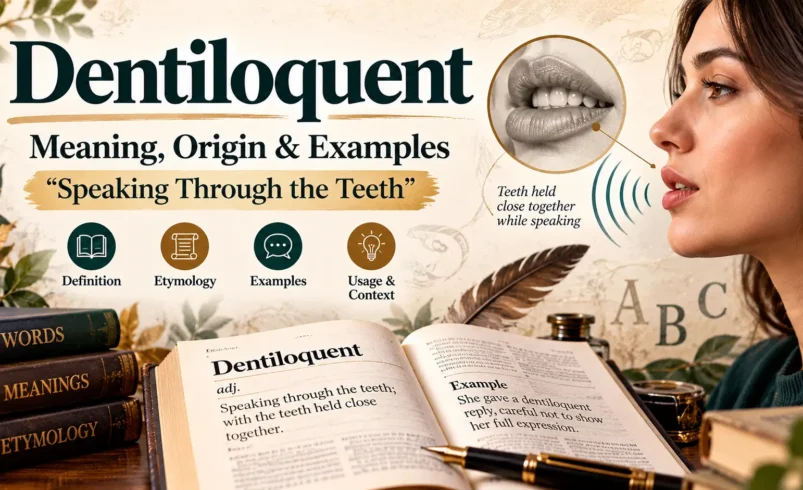
Dentiloquent is an exceptionally rare English adjective describing someone who speaks through their teeth, often while keeping the jaw relatively still and the teeth close together. In everyday language, the closest expression is “speaking through clenched teeth.”
Although the word may sound unfamiliar, the action it describes is recognizable. Imagine someone responding during an uncomfortable conversation without opening their mouth fully. Their words may sound restrained or compressed because of how their teeth and jaw are positioned. This manner of speaking can be described as dentiloquent.
The word has an interesting linguistic background. It combines elements associated with teeth and speaking, and its related vocabulary has historical roots extending back centuries. Yet despite its descriptive precision, dentiloquent has never become a common part of everyday English.
For readers interested in unusual vocabulary, the word offers more than an unfamiliar definition. It demonstrates how English can describe a specific physical detail of communication and how rare expressions can survive in dictionaries long after they disappear from ordinary conversation.
What Does Dentiloquent Mean?
Dentiloquent means speaking through the teeth, particularly when the teeth are kept together or nearly closed.
The definition concerns the physical manner in which speech is produced rather than the message being communicated.
During ordinary conversation, the jaw, lips, tongue, and other speech structures move to produce recognizable sounds.
When someone speaks with their teeth held unusually close together, some of those movements may become restricted.
The resulting speech can sound tight, restrained, or slightly muffled, although it may remain understandable.
This is the behavior described by dentiloquent.
A simple example is someone speaking through tightly held teeth while trying not to interrupt an argument. The individual continues to communicate, but the jaw remains relatively still.
The word itself does not explain why the person is speaking that way.
Anger, discomfort, nervousness, dramatic performance, or deliberate restraint may provide the context. None of those emotions is necessary for the definition.
That distinction makes dentiloquent more precise than descriptions that treat it as another word for anger.
Is Dentiloquent a Real English Word?
Yes. Dentiloquent is a documented English word, although it is extremely uncommon.
Its unusual status deserves some explanation.
Collins Dictionary includes dentiloquent in its New Word Suggestion section, where it is defined as talking through one’s teeth.
The submission is dated August 23, 2012.
However, Collins identifies the expression as a word being monitored for evidence of usage.
That means the submission should not be confused with ordinary inclusion as a widely established modern dictionary headword.
The word also has a longer historical background than its Collins submission date suggests.
Rare words can appear in historical dictionaries even when they are not commonly used by speakers.
Some may have circulated among writers or scholars. Others may have been recorded in specialized vocabulary collections without gaining widespread popularity.
Dentiloquent belongs to this interesting category of extremely uncommon descriptive language.
It is not simply a modern internet invention, but describing it as a familiar contemporary word would also be misleading.
Where Does Dentiloquent Come From?
The structure of dentiloquent provides a helpful clue to its meaning.
Its components are associated with Latin words for teeth and speaking.
Understanding those elements makes the unfamiliar adjective easier to recognize.
The Latin Root Connected With Teeth
The first part of dentiloquent is associated with the Latin noun dens, meaning tooth.
Its genitive form is dentis.
The same linguistic family appears in familiar English words related to teeth.
Examples include dental, dentist, dentition, and denture.
When readers recognize the dent-related element, they can associate the beginning of dentiloquent with teeth.
This is useful because the word’s meaning depends directly on the physical position of the teeth during speech.
The Latin Root Connected With Speaking
The second important element is related to the Latin verb loqui, meaning to speak.
English contains several words derived from the same speech-related family.
Eloquent describes effective or expressive communication.
Loquacious refers to someone who talks a great deal.
Soliloquy refers to speech delivered by a person speaking to themselves, particularly in dramatic or literary contexts.
Dentiloquent belongs to the same broad family of word formations involving speech.
Combining the tooth-related and speaking-related elements produces the essential meaning: speech through the teeth.
The Connection With Dentiloquy
The related noun dentiloquy provides additional historical evidence.
The Online Etymology Dictionary records dentiloquy with the meaning of speaking through the teeth or with the teeth closed.
It dates that noun to 1737.
This date belongs specifically to the recorded history of dentiloquy and should not automatically be treated as the date when dentiloquent itself was invented.
Historical vocabulary research also connects dentiloquent with seventeenth-century English lexicography.
The broader history shows why it is important to distinguish the first known documentation of a word from its actual invention or first spoken use.
The Historical Background of Dentiloquent
The history of rare English vocabulary is closely connected with the development of dictionaries.
Before modern dictionaries became widely available, scholars and writers compiled collections of unusual, specialized, and foreign-derived words.
These works helped readers understand language that might appear in literature, law, science, or academic discussion.
An important example is Thomas Blount’s Glossographia, published in 1656.
The dictionary contained explanations of difficult words and their origins.
Historical discussions of unusual vocabulary identify dentiloquent among the terms associated with this early dictionary tradition.
However, documentary evidence from a dictionary is not necessarily proof that a word was commonly spoken.
A dictionary compiler may record expressions encountered in specialized texts, borrow entries from earlier references, or include words that never become popular.
For dentiloquent, the available historical references support treating the word as old and documented, but its precise first use and historical frequency should not be stated with certainty.
This is part of what makes the term interesting.
It illustrates the difference between a word existing in the linguistic record and becoming a regular part of everyday language.
How Is Dentiloquent Used in a Sentence?
Dentiloquent functions as an adjective.
An adjective describes a noun, so the word can modify expressions such as voice, reply, remark, conversation, or delivery.
It can also describe a person when the sentence clearly concerns their manner of speaking.
The following sentences are original illustrative examples rather than quotations from published literature.
Examples in Everyday Situations
“The manager gave a dentiloquent reply as the discussion became uncomfortable.”
Here, dentiloquent describes how the reply was delivered.
“She remained outwardly calm, but her dentiloquent words revealed a tightness in her jaw.”
This example uses the physical description alongside contextual information about the speaker’s behavior.
“His dentiloquent response was difficult to hear across the crowded room.”
In this sentence, the word helps describe a restricted manner of speaking.
“The actor adopted a dentiloquent delivery during the confrontation scene.”
This example shows that speaking through the teeth can be deliberate rather than an automatic emotional reaction.
“The character’s dentiloquent warning made the dialogue feel unusually restrained.”
Here, the adjective contributes to the atmosphere of a fictional scene.
When Does the Word Sound Natural?
Dentiloquent is most appropriate when a writer wants to emphasize a specific manner of speaking.
It can be effective in fiction, character descriptions, theatrical commentary, or articles about unusual vocabulary.
However, its rarity means many readers will not immediately understand it.
For general audiences, the phrase “speaking through clenched teeth” is usually clearer.
A writer can introduce dentiloquent with a short explanation before using it independently.
This allows the term to add precision without making the passage unnecessarily difficult.
What Does Dentiloquent Speech Sound Like?
Dentiloquent speech does not necessarily produce one consistent vocal sound.
The defining feature is the restricted positioning of the teeth and jaw.
The audible effect depends on how the individual produces the words.
A person may sound compressed or restrained while speaking through nearly closed teeth.
Some sounds may be less distinct because the normal movements used in articulation are limited.
However, a speaker can still produce understandable words while keeping the mouth relatively closed.
This means dentiloquent should not automatically be equated with unintelligible speech.
The amount of jaw movement, the speaker’s habits, and the words being spoken can all influence the result.
Does It Always Sound Angry?
No.
Anger is one possible interpretation of speech delivered through clenched teeth, but it is not part of the basic definition.
In fiction, a character might speak this way while trying to suppress frustration.
During a theatrical performance, an actor might deliberately use the same physical manner to suggest tension.
Another person might speak with limited jaw movement for reasons unrelated to anger.
The surrounding situation determines the emotional interpretation.
The adjective itself describes the manner of speech.
Does It Mean Speaking Quietly?
Not necessarily.
Someone speaking through the teeth may sound quiet, but volume is a separate feature.
A person can speak softly with their mouth open normally.
Likewise, someone might speak audibly while keeping the teeth relatively close together.
Dentiloquent concerns articulation and mouth position, not a particular level of loudness.
Dentiloquent vs. Other Words for Speaking
English has numerous words describing different qualities of speech.
Some refer to volume. Others concern clarity, fluency, emotion, or the amount a person talks.
Dentiloquent is distinctive because it describes a particular physical manner of speaking.
Dentiloquent vs. Mumbling
Mumbling usually describes speech that is difficult to understand because words are not articulated clearly.
Dentiloquent refers specifically to speaking through the teeth.
A person might both mumble and speak through their teeth, but the two expressions are not interchangeable.
The distinction is between reduced clarity and the physical position associated with speech production.
Dentiloquent vs. Muttering
Muttering usually involves speaking in a low or subdued voice.
It can occur when someone speaks privately, expresses dissatisfaction, or does not intend to be heard clearly.
Dentiloquent does not necessarily involve a low voice.
A person can mutter without clenching their teeth, just as someone can speak through their teeth without muttering.
Dentiloquent vs. Whispering
Whispering involves a particular method of producing speech without ordinary vocal-fold vibration.
Dentiloquent describes the position of the teeth and jaw.
A person may whisper while keeping their mouth open normally.
These expressions describe different aspects of how speech is produced.
Dentiloquent vs. Eloquent
Eloquent is a far more familiar word.
It describes someone who expresses ideas fluently, effectively, or persuasively.
Dentiloquent does not describe communication skill.
Someone can deliver a persuasive statement through clenched teeth, but that does not make the words synonymous.
Dentiloquent vs. Loquacious
Loquacious describes someone who talks a great deal.
Dentiloquent describes how someone speaks.
A person could be both loquacious and dentiloquent, although the combination would be unusual.
The first adjective concerns quantity of speech; the second concerns its physical delivery.
Dentiloquent, Dentiloquy, and Dentiloquist
Several related words share the same central idea.
Their grammatical roles differ.
Dentiloquent is an adjective describing speech through the teeth.
Example: “The dentiloquent reply surprised the audience.”
Dentiloquy is a noun referring to the act or practice of speaking through the teeth.
Example: “The actor’s deliberate dentiloquy contributed to the character’s tense appearance.”
Dentiloquist is a rare noun associated with someone who speaks through the teeth.
Example: “The performer was described as a dentiloquist because of the unusual manner of delivery.”
These examples illustrate the grammatical relationship between the words.
None is common in modern everyday speech.
Understanding the family is useful for vocabulary study, but readers do not need to memorize all three forms to understand the essential meaning.
Is Dentiloquent a Medical or Dental Term?
Dentiloquent should not be confused with the name of a medical diagnosis.
Although it refers to teeth and speech, it is primarily a descriptive vocabulary term.
The word does not, by itself, identify a dental disorder, speech disorder, or specific problem affecting the jaw.
Speech production involves coordinated movement of several structures, including the tongue, lips, jaw, and vocal system.
Changes in these movements can influence how words sound.
However, observing that someone speaks with their teeth close together does not establish why the behavior occurs.
A person may deliberately restrict jaw movement during a performance or conversation.
Other circumstances may involve physical discomfort or difficulty moving the jaw.
The word dentiloquent does not distinguish between those situations.
Persistent pain, restricted jaw movement, or a new speech difficulty should be evaluated according to the actual symptoms rather than interpreted through a rare literary adjective.
Why Is Dentiloquent So Rare?
One reason dentiloquent remains uncommon is that English already has a familiar phrase describing the same basic behavior.
Most speakers naturally say that someone is talking through their teeth or speaking through clenched teeth.
These expressions are immediately understandable.
Dentiloquent offers a shorter alternative, but its unfamiliarity may reduce clarity.
For ordinary conversation, there is little practical reason to replace a widely recognized phrase with an obscure adjective.
The Difference Between Precision and Familiarity
Rare words can express specific ideas efficiently.
However, efficiency depends on the reader understanding the expression.
A sentence containing dentiloquent may be shorter than one using a longer description, but it may require an explanation.
In literary writing, this can be worthwhile when unusual vocabulary contributes to tone or style.
In instructions, professional communication, or general informational writing, familiar wording is often more effective.
Good writing depends on choosing language that serves the reader.
The rarest available word is not automatically the best one.
Historical Vocabulary and Modern Usage
English contains many expressions that remain in historical dictionaries but rarely appear in contemporary conversation.
Some describe outdated objects or practices.
Others identify experiences for which simpler alternatives have become more common.
Dentiloquent belongs to the second category.
The action it describes remains recognizable, but the word itself is largely unfamiliar.
Its survival in vocabulary discussions reflects the continuing interest readers have in uncommon and historically documented expressions.
Why Does Dentiloquent Interest Writers?
Dentiloquent can be particularly useful in descriptive fiction.
A writer often needs to communicate how dialogue is delivered without explaining every physical movement.
An adjective can help create that impression.
For example, a scene involving two characters in a disagreement may contain the sentence:
“His answer was brief and dentiloquent.”
The word suggests that he spoke through tightly held teeth.
If the surrounding scene establishes anger or discomfort, readers can connect the manner of speaking with the character’s emotional state.
However, the adjective should not be expected to communicate the complete emotion independently.
Creating Character Detail
Small physical details can make fictional characters feel more recognizable.
A character might speak rapidly, pause before answering, avoid eye contact, or keep the jaw tight.
These details can contribute to the reader’s understanding of the scene.
Dentiloquent gives writers a concise way to describe one such detail.
Its usefulness is strongest when the physical behavior matters.
Avoiding Overwritten Dialogue
An unfamiliar adjective can attract unnecessary attention if it appears in a passage that otherwise uses simple language.
A writer should consider the intended readership.
For a general audience, “he spoke through clenched teeth” may communicate the scene more effectively.
For readers who enjoy unusual vocabulary, dentiloquent may add a distinctive literary quality.
The choice depends on context rather than an absolute rule.
Dentiloquent in Body Language and Communication
Communication involves more than the literal meaning of words.
Listeners also notice facial expressions, posture, timing, gestures, and vocal delivery.
Speaking through tightly held teeth is one physical behavior that can influence how a message is perceived.
A person might say an ordinary sentence while holding their jaw unusually still.
Listeners may interpret the delivery differently from a relaxed version of the same sentence.
However, interpreting body language requires caution.
One gesture or vocal habit cannot reliably reveal a person’s private thoughts.
A tight jaw may accompany frustration in one situation and have an unrelated explanation in another.
For this reason, dentiloquent should remain a description of observable behavior rather than a tool for diagnosing emotions or personality.
This distinction is especially important in communication analysis.
The same physical behavior can have different meanings depending on context, culture, individual habits, and the circumstances of the conversation.
How to Remember the Meaning of Dentiloquent
A simple memory technique is to divide the word into its two main linguistic ideas.
The first is connected with teeth.
The second is connected with speaking.
Together, they describe speech produced through the teeth.
Readers who already recognize the word dental may find the first connection especially easy to remember.
The speech-related element also appears in other English vocabulary, including eloquent and loquacious.
Recognizing these shared roots can help readers understand unfamiliar words without memorizing separate definitions.
However, related roots do not mean that all the resulting words are synonyms.
Dentiloquent concerns a manner of speaking, eloquent concerns expressive ability, and loquacious concerns talking a great deal.
Should You Use Dentiloquent in Everyday English?
There is nothing inherently incorrect about using a documented rare word in an appropriate context.
However, effective communication should prioritize understanding.
If someone is writing an academic discussion of unusual vocabulary, dentiloquent may be directly relevant.
It may also work in literary prose when the unusual style is intentional.
For a casual message, workplace email, or general news article, simpler wording is usually preferable.
Consider the following alternatives:
“She answered through clenched teeth.”
“His reply sounded tight and restrained.”
“He spoke without opening his mouth very far.”
Each sentence communicates an observable detail without requiring knowledge of an obscure word.
Dentiloquent can be useful, but it should be a deliberate choice rather than an attempt to make ordinary writing appear more sophisticated.
Frequently Asked Questions
What is the simple meaning of dentiloquent?
Dentiloquent means speaking through the teeth, usually while keeping the teeth together or nearly closed.
Is dentiloquent a real word?
Yes. It is historically documented and appears in Collins Dictionary’s New Word Suggestion section. However, it remains extremely rare in modern English.
What part of speech is dentiloquent?
Dentiloquent is an adjective. It describes a person, voice, reply, or other expression associated with speaking through the teeth.
Does dentiloquent mean angry?
No. The word describes how someone speaks, not necessarily how they feel. Anger may be suggested by the situation, but it is not required.
What is the noun form of dentiloquent?
Dentiloquy is the related noun. It refers to the act or practice of speaking through the teeth.
Is dentiloquent related to dentistry?
The word contains a tooth-related linguistic element, but it is not a standard dental diagnosis or treatment term.
Is dentiloquent the opposite of eloquent?
No. The words describe different characteristics. Eloquent concerns effective expression, while dentiloquent concerns the physical manner of speech.
Is dentiloquent commonly used in American English?
No. It is an extremely rare expression and is unlikely to appear regularly in everyday American conversation. Most speakers use the phrase “speaking through clenched teeth.”
Final Thoughts
Dentiloquent is a rare but meaningful piece of English vocabulary that describes speaking through the teeth.
Its linguistic structure connects the concepts of teeth and speech, while related historical vocabulary helps explain its background.
Although it may suggest tension or restraint in a particular scene, the word does not automatically imply anger, nervousness, or a medical condition.
Its greatest value lies in precise description, especially in literary writing and discussions of unusual words.
For everyday communication, the familiar phrase “speaking through clenched teeth” will usually be easier to understand.
Learning dentiloquent offers a reminder that English contains many highly specific expressions, even when simpler alternatives are more practical for modern readers.
More News: Witelovers: Meaning, Lifestyle, Design Ideas and What the Term Really Means