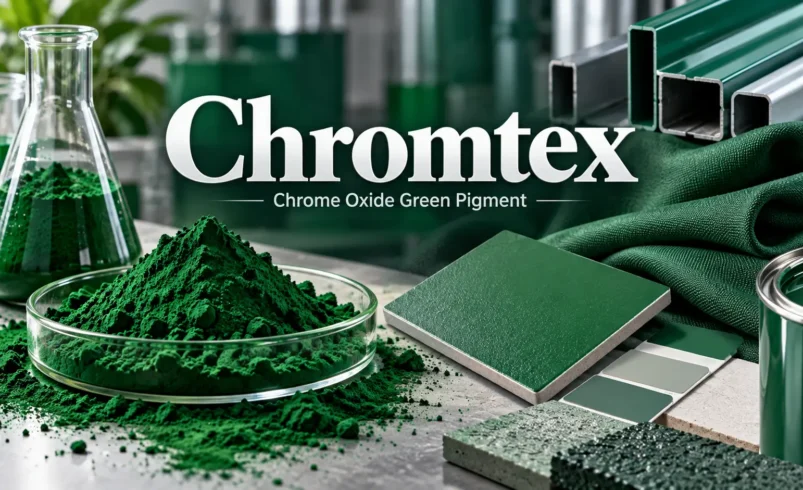
Chromtex is a name most clearly associated today with a range of industrial chrome oxide green pigments rather than one universal textile technology. The strongest current manufacturer documentation comes from ZWUKSO, a Polish company specializing in inorganic pigments, which lists CHROMTEX™ as its chrome oxide green product family. These pigments are based on chromium(III) oxide, written chemically as Cr₂O₃, and are intended for coloring products such as paints, plastics, concrete materials, bricks, tiles, rubber, flooring, enamel frits, and colored glass. The term becomes confusing because a separate Pakistani company called Chromatex Chemicals Pvt. Ltd. manufactures chemicals for textile pretreatment, dyeing, and finishing. The difference is only one letter, but they should not be treated as the same company, product, or technology.
What Is Chromtex?
The clearest current commercial meaning of Chromtex is the CHROMTEX™ series of synthetic chrome oxide green pigments supplied by ZWUKSO. The manufacturer describes the material as finely milled Cr₂O₃ with strong coloring ability, hiding power, and dispersibility. Those characteristics make it useful where manufacturers need a durable green inorganic pigment that can be distributed consistently through paints, plastics, cement-based products, and other industrial materials. ZWUKSO currently lists several grades under the CHROMTEX name, which means Chromtex is better understood as a product family rather than the scientific name of one completely new substance.
This is important because recent online articles have stretched the word much further. Some describe Chromtex as an advanced fabric technology, a textile finishing method, a smart material, or even a complete manufacturing philosophy. Those descriptions are difficult to reconcile with the primary manufacturer information. ZWUKSO does not present CHROMTEX™ as a general textile-processing system. It presents it as a chrome oxide green pigment range.
What Is CHROMTEX Made From?
CHROMTEX pigments are based on chromium(III) oxide, Cr₂O₃, commonly known as chrome oxide green. Chromium(III) oxide is an inorganic green pigment used where strong coloration and good material stability are important. It should not be confused simply because the word “chromium” appears in its name with every other chromium compound. Chemical behavior and safety depend heavily on the oxidation state, chemical form, concentration, exposure route, and actual product formulation.
For industrial users, the chemical name alone is not enough to make purchasing or handling decisions. The specific grade’s technical data sheet and safety data sheet matter because they provide information relevant to composition, handling, storage, application, and workplace precautions.
What Color Is Chromtex?
Chromtex belongs to the chrome oxide green family. Rather than being a bright neon or fluorescent green, chrome oxide pigments generally produce durable mineral-like greens suitable for industrial and construction products. The final appearance can still vary depending on the grade, concentration, surrounding formulation, substrate, thickness, surface finish, and manufacturing process.
A pigment mixed into concrete, for example, will not necessarily look exactly the same as the same pigment dispersed in plastic or paint. The surrounding material changes how light interacts with the pigment, which is one reason industrial color selection normally relies on real samples and technical testing rather than online photographs alone.
What Are the Main Chromtex Grades?
ZWUKSO currently lists several products within the CHROMTEX series rather than one single grade. Its published range includes:
- CHROMTEX GA-U
- CHROMTEX GA-R
- CHROMTEX GN
- CHROMTEX GA
- CHROMTEX GA-3
- CHROMTEX GA-6
- CHROMTEX GA-40
- CHROMTEX GA-60
These names identify different commercial grades within the product family. A buyer should not assume they are interchangeable simply because they share the Chromtex name. Pigment grades can differ in particle characteristics, shade, performance, intended application, or other technical properties, so the current manufacturer’s specification should be checked before substituting one grade for another.
Chromtex in Paints and Coatings
Paint is one of the applications specifically documented by the manufacturer. Pigments are a fundamental part of coatings because they provide color and can influence opacity, appearance, and formulation behavior. ZWUKSO describes CHROMTEX as having high hiding power and good dispersibility, qualities that matter when pigment needs to distribute throughout a coating rather than remain in visible agglomerates.
A paint manufacturer would still need to evaluate the pigment inside its complete formulation. Resin system, fillers, solvents or water, additives, mixing equipment, pigment loading, application method, and intended exposure can all affect the result. A general product description therefore should not be treated as a substitute for formulation testing.
Chromtex in Plastics
ZWUKSO also lists plastics among CHROMTEX applications. Pigments used in polymers need to distribute consistently through the material and produce the desired shade without creating unacceptable processing or performance problems. The final suitability depends on the polymer type, manufacturing temperature, pigment loading, processing equipment, and required finished appearance.
This is why simply saying “Chromtex works in plastics” is too broad for a manufacturer making a real product decision. The specific resin system and grade need to be tested. A pigment that performs well in one application may require different concentrations or processing conditions in another.
Chromtex in Concrete
Construction materials are another significant documented application. CHROMTEX can be used for coloring concrete roof products, facade mixtures, bricks, tiles, and other building materials. In these applications, an inorganic pigment can provide color throughout or across the visible portion of the material rather than relying only on a thin decorative surface layer.
Coloring concrete still requires careful dosage and mixing. Cement color, aggregates, water content, curing conditions, pigment concentration, and surface treatment can all change the final shade. Two manufacturers using the same green pigment can therefore produce noticeably different finished colors.
Chromtex in Bricks and Tiles
Bricks and tiles are specifically included in the manufacturer’s application list. For products such as these, color consistency matters because units are usually installed side by side over a large visible area. Even small shade differences can become noticeable once hundreds of units are combined.
Manufacturers therefore need controlled raw materials, accurate pigment dosing, consistent mixing, and stable processing. Pigment selection is only one part of that system. The same commercial grade can still look different if the production process changes.
Chromtex in Rubber Products
Rubber is another documented CHROMTEX application. Pigment can be introduced where a green coloration is required for molded or processed rubber goods. As with plastics, however, suitability depends on the complete formulation and processing conditions.
Rubber products can contain polymers, reinforcing fillers, curing agents, oils, stabilizers, and several other additives. A pigment has to function within that mixture without producing unacceptable changes in processing or finished appearance. Industrial users should therefore test the actual formulation rather than assuming general compatibility means automatic suitability.
Chromtex in Flooring
The manufacturer also includes flooring among the potential uses for its chrome oxide green pigments. This could involve applications where a durable green pigment is needed in a flooring material or coating system. The exact manufacturing method will determine how much pigment is required and how the final shade appears.
Flooring also faces practical demands such as wear, cleaning, chemicals, sunlight, and repeated foot or equipment traffic. Those performance properties come from the complete flooring system, not from the pigment alone. Chromtex provides color; it should not automatically be credited with every durability property of the finished floor.
Chromtex in Glass and Enamel Frits
Colored glass and enamel frits are also listed among CHROMTEX applications. These uses illustrate why the term should not be reduced to textiles. The documented product family has a much broader industrial coloring role, extending across construction, polymers, coatings, glass-related applications, and other manufactured materials.
Processing temperatures and chemical compatibility can become particularly important in applications involving glass or enamel. A manufacturer considering the pigment for such use should work from the technical specification of the exact grade rather than relying on a general description of chrome oxide green.
Is Chromtex a Textile Technology?
The primary evidence does not support treating CHROMTEX™ as a universal textile technology. ZWUKSO’s documentation describes a chrome oxide green pigment series and lists paints, plastics, construction materials, rubber, flooring, enamel frits, and colored glass among its applications. Its current CHROMTEX page does not describe a textile pretreatment, dyeing, or fabric-finishing technology.
The textile connection found across the SERP appears largely because of another name: Chromatex Chemicals Pvt. Ltd. Chromatex, with an extra “a,” is a real Pakistani business that manufactures textile auxiliary chemicals. Mixing those two names can easily turn correct information about Chromatex into incorrect information about Chromtex.
Chromtex vs Chromatex: The Difference Matters
This spelling difference is probably the most important thing to understand about the keyword.
Chromtex / CHROMTEX™ is currently documented by ZWUKSO as a chrome oxide green pigment series.
Chromatex Chemicals Pvt. Ltd. is a Pakistan-based manufacturer of textile-processing auxiliary chemicals.
Chromatex says it has served the textile industry since 1999 and manufactures products used in pretreatment, dyeing, and finishing. Its range includes antifoams, enzymes, peroxide stabilizers, sequestering agents, wetting agents, detergents, anti-creasing products, leveling agents, dye-fixing products, pH regulators, softeners, emulsions, binders, and other auxiliaries.
They may appear beside one another in search results, but that does not make them the same business.
What Does Chromatex Chemicals Actually Do?
Chromatex Chemicals describes itself as a manufacturer of auxiliary chemicals for textile processing. In a textile mill, auxiliary chemicals perform supporting functions during fabric preparation, dyeing, washing, printing, and finishing. They are not necessarily the main dyes themselves. Instead, they help control processes such as wetting, cleaning, peroxide treatment, dye leveling, fixing, softening, and printing.
The company states that it operates in Pakistan and lists locations connected with Lahore, Faisalabad, and Karachi. It also states that it has served the textile industry since 1999. Those facts belong to Chromatex, not automatically to CHROMTEX™ pigment.
Why Do So Many Chromtex Articles Talk About Fabric?
The spelling makes the error surprisingly easy. The ending “tex” naturally looks related to textiles, and the real company Chromatex is only one letter away. Once one article combines the two, later publishers can repeat the same association.
The pattern can develop like this:
- a searcher types “Chromtex”;
- search results also surface Chromatex;
- an article assumes the names refer to the same thing;
- genuine Chromatex textile information is rewritten as Chromtex information;
- another article expands the idea into “advanced textile technology”;
- the repeated description begins looking established.
This is why primary manufacturer sources matter more than the number of blogs repeating a claim.
Is Chromtex a Fabric?
No evidence from the current manufacturer documentation suggests that CHROMTEX™ itself is a fabric. It is a pigment product family. The pigment can become part of a manufactured material, but it is not a textile fiber, woven cloth, or standalone fabric.
Calling Chromtex a “high-performance fabric” would therefore confuse the product with an entirely different category of material.
Is Chromtex a Dye?
A pigment and a dye are not necessarily the same thing. In general, dyes dissolve in the application medium or have an affinity for the substrate, while pigments are insoluble particles that need to be dispersed or incorporated into a material. CHROMTEX is documented specifically as a synthetic chrome oxide green pigment.
That distinction matters in manufacturing because pigments and dyes behave differently in formulation, processing, transparency, dispersion, and application.
Is Chromtex a Coating?
Chromtex is also not a complete coating by itself. It can be used as a pigment in paints, primers, fillers, and related products, but the finished coating contains many additional components. A paint typically needs a binder, carrier, additives, and other ingredients alongside its pigments.
Saying Chromtex is “used in coatings” is therefore more accurate than saying Chromtex itself is a coating system.
What Does Good Dispersibility Mean?
ZWUKSO describes CHROMTEX as having very good dispersibility. In practical terms, dispersion is the process of distributing pigment particles evenly through a material. Poor dispersion can lead to clumps, inconsistent color, reduced hiding performance, or processing difficulties.
Good dispersibility can therefore make formulation easier, but actual performance still depends on manufacturing equipment, mixing time, surrounding ingredients, and the selected grade.
What Is Hiding Power?
Hiding power refers to a pigment or coating’s ability to obscure the surface or underlying color beneath it. Strong hiding performance can help manufacturers achieve coverage without needing an excessively transparent finish.
The exact hiding performance in a finished product depends on more than the pigment name. Particle size, concentration, film thickness, binder, substrate, and other pigments or fillers can all contribute.
Is Chromtex Weather Resistant?
Chrome oxide green pigments are commonly selected for demanding applications partly because this pigment family is known for robust performance, but specific weathering claims should be tied to the exact commercial grade and finished formulation. CHROMTEX being suitable for facade mixtures, concrete roofing, bricks, and tiles indicates that the manufacturer positions it for outdoor construction uses.
However, the lifespan of a facade, roof tile, or coating is determined by the complete material system. It would be misleading to promise a certain number of years of outdoor durability solely because Chromtex pigment is present.
Can Chromtex Be Used Outdoors?
The manufacturer’s documented construction uses include facade mixtures, concrete roofing, bricks, and tiles, which clearly involve outdoor applications. The appropriate pigment grade and formulation should still be validated for the specific project.
Outdoor performance can be affected by ultraviolet exposure, water, temperature changes, pollution, chemical contact, substrate composition, and manufacturing quality.
How Is Chromtex Supplied?
ZWUKSO’s current product page says the CHROMTEX series is available in 25 kg net bags and 1,000 kg big bags. That packaging is another clue that this is an industrial raw material rather than a consumer-facing fabric treatment or small household product.
A manufacturer purchasing at that scale would normally select a grade based on technical requirements, run production trials, and consult the current technical and safety documentation.
Is Chromtex Safe?
Safety cannot responsibly be reduced to “safe” or “unsafe” from the product name alone. Industrial pigments should be handled according to the current safety data sheet for the specific grade. Workers may need controls related to dust, respiratory exposure, eye contact, housekeeping, storage, and personal protective equipment depending on the work process.
Another important point is that chromium(III) oxide should not automatically be confused with hexavalent chromium compounds. Chromium chemistry includes multiple chemical forms with very different properties and risk profiles. Product-specific documentation matters much more than reacting to the word chromium alone.
What Buyers Should Check Before Ordering Chromtex
Industrial buyers should focus on technical compatibility rather than marketing language. Before selecting a grade, check:
- exact CHROMTEX grade;
- technical data sheet;
- safety data sheet;
- target substrate or formulation;
- required shade;
- pigment dosage;
- processing temperature;
- dispersion method;
- chemical compatibility;
- weathering requirements;
- batch consistency;
- and packaging quantity.
A sample or pilot production run can be far more useful than choosing a grade based only on an online color image.
Is Chromtex Environmentally Friendly?
Broad sustainability claims should be treated carefully unless tied to specific data. ZWUKSO says it is involved in inorganic pigments and also offers eco-pigment products, but that does not automatically mean every CHROMTEX grade should be marketed using a universal “eco-friendly” claim.
Environmental performance needs context: raw materials, manufacturing energy, emissions, waste, product lifespan, disposal, and the finished formulation can all matter. Sustainability should therefore be assessed from current product and supply-chain documentation rather than inferred from a color pigment’s name.
How Chromtex Differs From Iron Oxide Pigments
Iron oxides and chrome oxide green are both widely used categories of inorganic pigments, but they provide different colors and technical characteristics. Iron oxide pigments commonly produce reds, yellows, blacks, and browns, while chrome oxide green supplies a characteristic green range.
A manufacturer choosing between pigment families is usually not deciding which one is universally “better.” The decision depends on the target shade, cost, process conditions, performance requirements, and formulation.
How Chromtex Differs From Organic Green Pigments
Organic pigments can provide bright, highly saturated shades that may differ significantly from mineral-like chrome oxide greens. Inorganic chrome oxide green, meanwhile, is used where its specific shade and industrial performance characteristics are appropriate.
Again, this is not a simple quality ranking. Different pigment chemistries exist because manufacturers need different combinations of color, stability, opacity, process compatibility, and price.
Why Chromtex Is Used in Construction Materials
Construction is one of the more logical markets for an inorganic pigment because building products often need stable coloration across large batches and long service periods. Concrete blocks, roof products, facade mixes, tiles, and bricks also need pigments that can work within mineral-based production environments.
CHROMTEX’s manufacturer specifically lists these building applications, making construction one of its clearest verified use cases.
Can Chromtex Improve Material Strength?
A pigment should not automatically be credited with improving the mechanical strength of a finished material. Its primary documented role is coloration. Concrete strength, plastic strength, rubber performance, and coating durability depend on complete formulations and manufacturing processes.
Some current articles claim Chromtex makes fabrics or materials inherently stronger. That type of claim needs specific testing data. The presence of a pigment alone does not prove improved tensile strength, abrasion resistance, impact performance, or structural durability.
Is Chromtex a New Technology?
No evidence suggests that the exact CHROMTEX product should be described as a mysterious newly invented smart-material technology. ZWUKSO itself has operated in the inorganic pigment market since 1989 and presents CHROMTEX alongside its established industrial pigment portfolio.
What appears relatively new is the surge of general web content around the keyword. That online attention should not be confused with the invention date of chrome oxide green chemistry or industrial pigment technology.
Chromtex vs Chromatex in Simple Terms
The easiest way to remember the difference is:
- CHROMTEX™ = chrome oxide green pigment series
- ZWUKSO = documented CHROMTEX supplier
- Cr₂O₃ = underlying chrome oxide green chemistry
- Chromatex Chemicals = separate Pakistani textile chemical company
- Chromatex products = textile auxiliaries for pretreatment, dyeing and finishing
One missing letter completely changes the subject.
Why Exact Spelling Matters for Industrial Searches
In ordinary conversation, a one-letter spelling error is often harmless. In industrial sourcing, it can send a buyer toward the wrong manufacturer, chemical family, safety document, or technical specification.
Searching “Chromtex SDS” should ideally lead toward the relevant CHROMTEX pigment documentation. Searching “Chromatex textile chemicals” should lead toward the Pakistani textile auxiliary manufacturer.
Combining those results can create genuine purchasing and technical mistakes.
Common Chromtex Misconceptions
The most common misconception is that Chromtex is a universal textile treatment. Current primary documentation does not support that. Another is that Chromtex and Chromatex are alternate spellings of the same company. They are not established that way by the companies’ own websites.
Other misleading assumptions include:
- Chromtex is a special fabric;
- Chromtex is one single chemical grade;
- Chromtex automatically improves fabric comfort;
- Chromtex is a smart textile platform;
- Chromtex and Chromatex are the same brand;
- every chromium compound has the same safety profile;
- and every material containing Chromtex gains identical durability.
The verified story is narrower but much more useful: CHROMTEX is an industrial chrome oxide green pigment range.
Final Thoughts
Chromtex becomes much easier to understand once the similar names are separated. The strongest current manufacturer evidence identifies CHROMTEX™ as a ZWUKSO range of finely milled synthetic chrome oxide green pigments based on Cr₂O₃. The manufacturer lists applications including paints, plastics, concrete facade mixtures, concrete roofing, bricks, tiles, rubber products, flooring, enamel frits, and colored glass. It also lists several individual CHROMTEX grades and industrial packaging options.
The textile story belongs mainly to a different spelling. Chromatex Chemicals Pvt. Ltd. is a real Pakistan-based manufacturer that says it has supplied textile auxiliary chemicals since 1999 for pretreatment, dyeing, and finishing. Its genuine textile connection should not be transferred automatically to CHROMTEX pigment simply because the names look similar.
For buyers, researchers, or anyone writing about the term, that distinction solves most of the confusion. Chromtex should be researched through the exact grade and ZWUKSO technical documentation. Chromatex should be researched as a separate textile-chemical company. The extra “a” matters.
Frequently Asked Questions
What is Chromtex?
Chromtex most clearly refers to CHROMTEX™, a series of synthetic chrome oxide green pigments supplied by ZWUKSO and based on chromium(III) oxide, Cr₂O₃.
Is Chromtex a textile technology?
The current CHROMTEX manufacturer does not describe it as a general textile technology. Textile-related search results are often confused with Chromatex Chemicals, a separate company.
What is Chromtex used for?
Documented uses include paints, plastics, primers, fillers, facade mixtures, concrete roofing, bricks, tiles, rubber, flooring, enamel frits, and colored glass.
What is Chromtex made of?
The CHROMTEX pigment family is based on synthetic chromium(III) oxide, Cr₂O₃.
Is Chromtex the same as Chromatex?
No. CHROMTEX is documented as a pigment range, while Chromatex Chemicals Pvt. Ltd. is a separate Pakistani manufacturer of textile auxiliary chemicals.
What does Chromatex Chemicals manufacture?
Chromatex produces textile auxiliaries including enzymes, wetting agents, detergents, peroxide stabilizers, leveling agents, fixing agents, softeners, binders, and related processing chemicals.
Is Chromtex a dye?
It is documented as a pigment rather than a dye.
Can Chromtex be used in concrete?
Yes. ZWUKSO lists concrete roofing, facade mixtures, bricks, tiles, and other building-industry applications.
What Chromtex grades are available?
ZWUKSO currently lists grades including GA-U, GA-R, GN, GA, GA-3, GA-6, GA-40, and GA-60.
Is Chromtex safe?
Industrial users should follow the current safety data sheet for the exact grade and use appropriate handling and exposure controls. Safety should not be judged from the brand name alone.
Also Read: Wattios: Meaning, Watts, Power and Electricity Explained