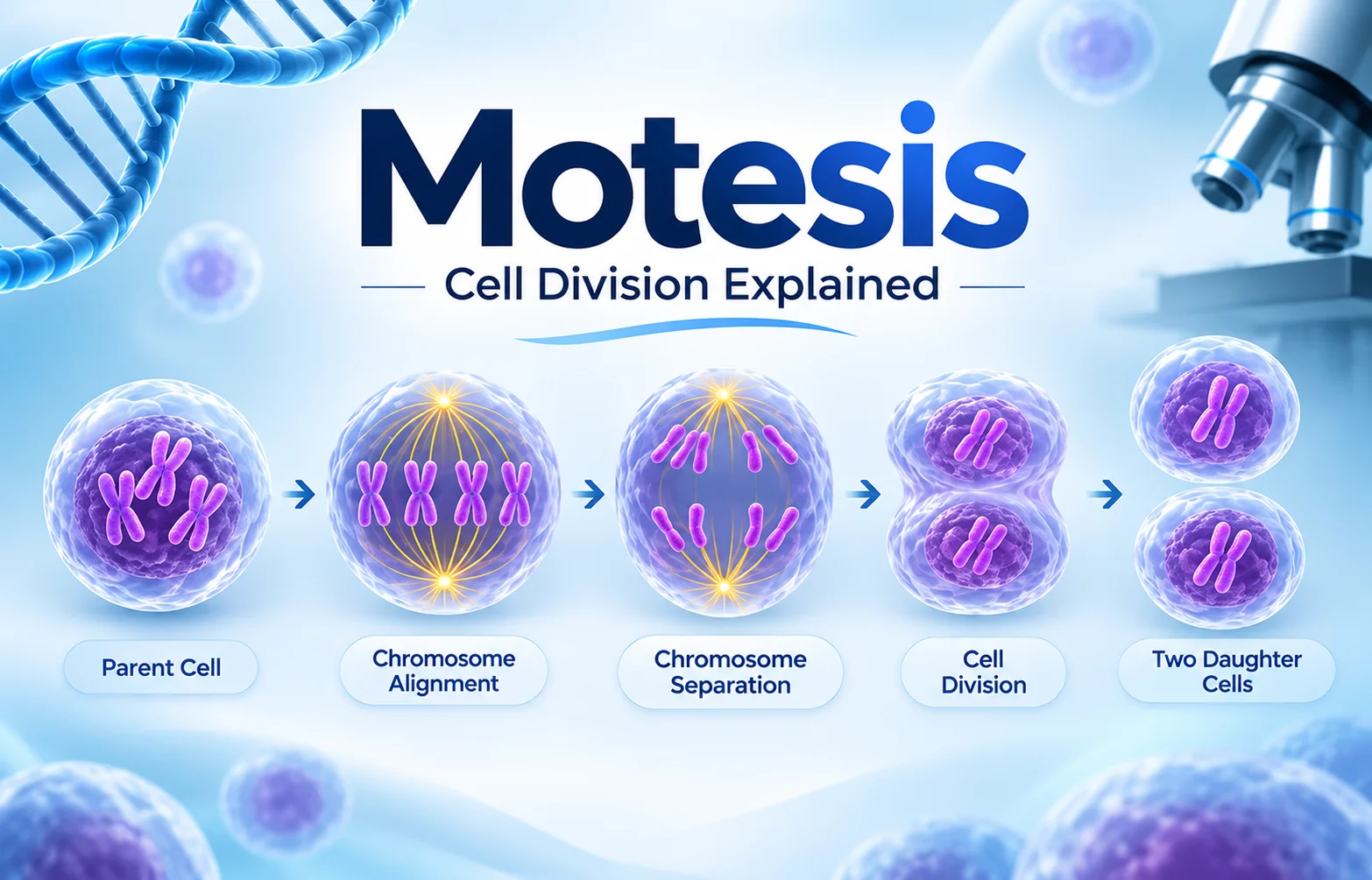
Life depends on countless microscopic activities that happen without us noticing. Every time a wound begins to heal, the skin renews itself, or a young organism grows, specialized biological mechanisms are working behind the scenes. One of these mechanisms is associated with the search term Motesis, which is commonly understood as a reference to mitosis, the process responsible for dividing duplicated chromosomes between two new cell nuclei.
Although Motesis is not a formally recognized term in biology, understanding mitosis reveals how living organisms maintain healthy tissues, produce new cells, and preserve essential genetic information. The process involves more than simply splitting a cell into two. It requires accurate DNA replication, chromosome organization, and carefully controlled separation to ensure that newly formed cells receive the genetic instructions they need.
The Biological Meaning Hidden Behind Motesis
Motesis is frequently confused with mitosis because of the similarity in spelling and pronunciation. In scientific terminology, mitosis describes the division of a cell’s nucleus in which duplicated chromosomes are separated into two sets. This process generally occurs in eukaryotic organisms, including animals, plants, and fungi, although its details can vary between organisms.
In humans, most ordinary body cells contain 46 chromosomes, organized into 23 pairs. These chromosomes carry DNA, which contains genetic instructions involved in cellular structure, development, and function. Before a cell enters mitosis, its DNA must be duplicated so that the resulting nuclei can receive equivalent chromosome sets.
The importance of this mechanism becomes evident when considering that the human body contains an enormous variety of cells. Different tissues require different rates of renewal, and mitosis helps provide new cells wherever division remains biologically possible and necessary.
What a Cell Must Accomplish Before It Can Divide
Cell division does not begin suddenly. A cell spends much of its life in a period known as interphase, during which it performs normal functions and prepares for possible division. Interphase includes three major phases: G1, S, and G2. During G1, the cell grows and carries out essential activities. In the S phase, DNA replication occurs, producing duplicated genetic material. G2 provides additional preparation before the cell enters mitosis.
This preparation explains why mitosis cannot be understood as an isolated event. Successful chromosome separation depends on the cell having completed earlier tasks correctly. Regulatory proteins and cellular checkpoints help coordinate progression through the cell cycle, reducing the likelihood of serious mistakes.
Some cells may also enter a non-dividing state known as G0. Depending on the cell type, this condition may be temporary or long-lasting. The ability to enter, remain in, or leave the cell cycle is part of how organisms manage growth and tissue stability.
The Four Turning Points That Shape Mitosis
The stages of mitosis are often presented as separate events, but they form one continuous process. Each stage changes the arrangement of chromosomes and prepares the cell for the next step.
Prophase: When Genetic Material Becomes Organized
During prophase, chromosomes become condensed and increasingly visible under a microscope. Each duplicated chromosome consists of two sister chromatids connected at a specialized region called the centromere. Meanwhile, structures involved in chromosome movement begin organizing the mitotic spindle. These early changes prepare the cell for accurate chromosome separation.
Metaphase: Finding the Correct Position
After the nuclear envelope breaks down during prometaphase and chromosomes attach to spindle microtubules, the chromosomes align near the middle of the cell. This arrangement is commonly called the metaphase plate. Proper attachment is essential because incorrect positioning can interfere with chromosome distribution.
Anaphase: The Separation That Changes Everything
Anaphase begins when sister chromatids separate and move toward opposite ends of the cell. Specialized proteins and spindle structures coordinate this movement. Once separated, the chromatids are considered individual chromosomes. The cell must distribute them accurately so that both developing nuclei receive the appropriate genetic material.
Telophase: Restoring Order After Division
During telophase, nuclear envelopes begin forming around the separated chromosome sets. Chromosomes gradually become less condensed, and the nuclei regain their organization. The cell is now approaching the completion of nuclear division, while the physical separation of its cytoplasm proceeds through cytokinesis.
Why Cell Division Does Not End With Mitosis
A common misunderstanding is that mitosis and complete cell division are exactly the same thing. Although closely connected, they describe different biological events. Mitosis involves division of the nucleus, while cytokinesis divides the cytoplasm and physically separates the daughter cells.
In animal cells, cytokinesis commonly involves a contractile ring that creates a cleavage furrow. As the furrow deepens, the cell eventually separates into two. Plant cells follow a different approach because their rigid cell walls prevent division through the same mechanism. Instead, a cell plate develops between the new nuclei and contributes to the formation of a separating cell wall.
This difference demonstrates how organisms can accomplish the same fundamental biological objective through different cellular structures.
The Everyday Work of Mitosis Inside the Human Body
Mitosis supports life in ways that are easy to overlook. Consider the skin, which regularly loses cells from its outer surface. New cells are produced in deeper layers, allowing the skin to maintain its protective function. Similar renewal occurs in parts of the digestive system, where the intestinal lining experiences continuous exposure to food, digestive substances, and mechanical activity.
Wound healing offers another example. When tissue is damaged, coordinated biological signals stimulate appropriate cells to participate in repair. Cell proliferation contributes to replacing lost cells, although healing also depends on inflammation, blood supply, extracellular matrix formation, and tissue remodeling.
Mitosis is equally important during early development. Repeated cell divisions increase cell numbers as an embryo grows. These cells subsequently undergo specialized developmental changes that allow tissues and organs to form. Without regulated cell multiplication, normal growth and development would not be possible.
When the Cell’s Internal Safety System Faces Trouble
The accuracy of mitosis is essential because chromosome distribution errors can affect cellular function. Cells contain regulatory mechanisms that monitor different stages of the cell cycle. One important safeguard is the spindle assembly checkpoint, which helps prevent chromosome separation until appropriate attachments have been established.
Despite these protections, mistakes sometimes occur. A daughter cell may receive an abnormal number of chromosomes, a condition known as aneuploidy. The consequences vary depending on the cell type, the chromosome involved, and whether the affected cell survives.
Failures in cell-cycle regulation are also relevant to cancer biology. Cancer cells can acquire changes that allow them to divide when normal cells would stop. However, cancer is a complex disease involving multiple genetic and cellular abnormalities, rather than simply being the result of mitosis itself.
Understanding this distinction is important because normal mitosis is necessary for health. The biological problem arises when the mechanisms controlling growth, survival, and division become disrupted.
Motesis and Meiosis Are Not Two Versions of the Same Outcome
Mitosis and meiosis are both forms of nuclear division, but their purposes and results differ substantially. Mitosis usually produces two genetically similar daughter nuclei while maintaining chromosome number. Meiosis involves two rounds of division following one round of DNA replication and typically generates four haploid cells.
The most important differences include:
- Mitosis generally supports growth, tissue maintenance, and certain forms of asexual reproduction.
- Meiosis is involved in sexual reproduction and the formation of haploid cells.
- Mitosis normally includes one nuclear division, while meiosis involves two.
- Mitosis generally preserves chromosome number, whereas meiosis reduces it by half.
- Meiosis generates genetic variation through processes including crossing over and independent assortment.
These distinctions help explain why ordinary tissue renewal and reproductive cell formation require different biological mechanisms.
Can Every Living Cell Perform Mitosis?
Not every cell has the same ability to divide. Mature human red blood cells, for instance, lack nuclei and cannot undergo mitosis. Many mature neurons also remain outside the active cell cycle and generally do not divide under normal circumstances.
Other cells, particularly certain stem cells and progenitor cells, retain the capacity for continued division. They can produce new cells that support tissue maintenance and regeneration. The balance between cell division, specialization, and cell death helps determine how different tissues function over time.
Mitosis is also characteristic of eukaryotic cells. Bacteria do not undergo conventional mitosis because they lack the membrane-bound nucleus and mitotic structures found in eukaryotes. Instead, most bacteria reproduce through a process called binary fission.
Questions Readers Often Have About Motesis
Is Motesis a scientifically accepted biological term?
Motesis is not a standard biological term for cell division. Mitosis is the established scientific name for the process of chromosome separation during eukaryotic nuclear division.
How many cells are produced after mitosis?
Mitosis creates two daughter nuclei. When followed by normal cytokinesis, the parent cell typically produces two daughter cells.
Does mitosis always create genetically identical cells?
Mitosis usually distributes equivalent genetic information, but spontaneous mutations or chromosome segregation errors can occasionally produce differences between daughter cells.
How long does the entire process take?
The duration varies considerably with organism, tissue type, and environmental conditions. Mitosis itself may take roughly an hour in some actively dividing mammalian cells, but the complete cell cycle often takes much longer.
Why is mitosis important for medical research?
Researchers study mitosis to understand tissue regeneration, developmental disorders, chromosome abnormalities, and the uncontrolled cell proliferation associated with cancer. Knowledge of mitotic regulation also contributes to the development and investigation of certain cancer treatments.
The Greater Lesson Behind Motesis and Living Cells
Motesis may begin as a simple search for the meaning of a biological word, but the correct concept, mitosis, introduces one of the fundamental mechanisms supporting life. Through coordinated preparation, chromosome movement, and nuclear division, cells preserve genetic continuity while enabling organisms to develop and maintain their tissues.
The most fascinating feature of mitosis is its precision. A microscopic cell must organize and distribute a large amount of genetic information while responding to internal regulatory signals. This coordination allows repeated divisions to support growth and repair without routinely disrupting the genetic instructions required for normal cellular function.
Understanding mitosis therefore provides more than academic knowledge. It offers a clearer picture of how living systems remain organized, how healthy tissues renew themselves, and why the regulation of cell division is essential to biological stability.
More Explore: Provascin Review 2026: Ingredients, Uses, Benefits, Safety and Current Availability