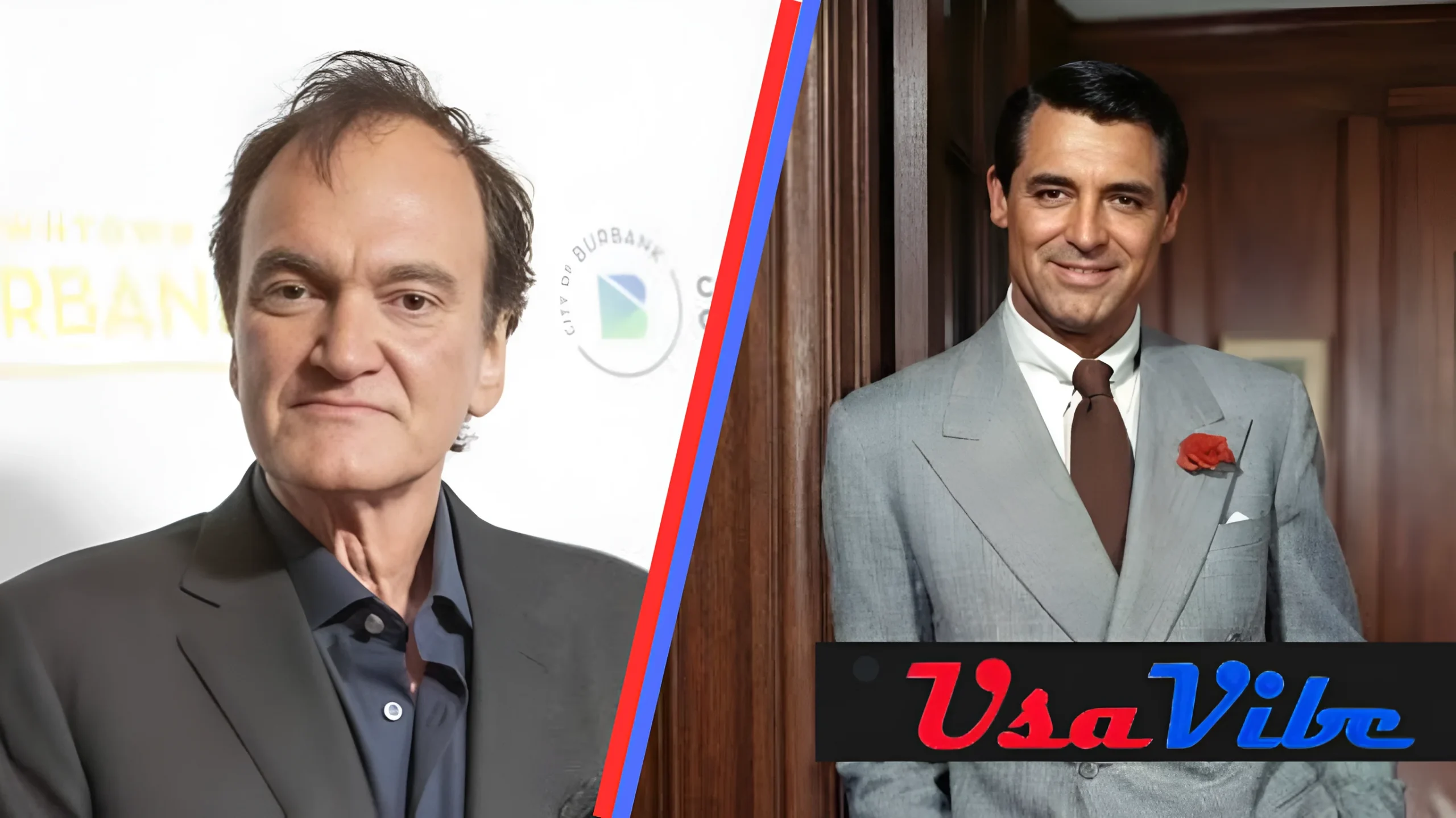
Imagine Cary Grant walking into a scene written by Quentin Tarantino. His immaculate suit, effortless charm, and perfectly timed dialogue would immediately command attention. But instead of exchanging clever remarks in a romantic comedy, he might find himself negotiating with a dangerous stranger in a dimly lit restaurant.
It’s an entertaining possibility, although one that never became reality.
Quentin Tarantino and Cary Grant belong to different generations of Hollywood history. Grant helped define the sophisticated leading man during cinema’s Golden Age, while Tarantino became famous for unconventional storytelling, sharp dialogue, and films that frequently challenge traditional expectations.
Their careers never crossed professionally, yet comparing their work reveals interesting connections between classical filmmaking and modern cinema.
Both understood the importance of memorable characters, audience expectations, and the power of a perfectly constructed scene.
But were they ever personally connected? Did Grant influence Tarantino’s movies? And what makes their cinematic legacies so enduring?
Their individual histories provide a fascinating place to begin.
Who Are Quentin Tarantino and Cary Grant?
Quentin Tarantino is an American filmmaker, screenwriter, producer, and actor known for movies including Pulp Fiction, Kill Bill, Django Unchained, and Once Upon a Time in Hollywood.
Born on March 27, 1963, in Knoxville, Tennessee, he developed a distinctive filmmaking style influenced by crime thrillers, Westerns, martial arts movies, and international cinema.
Cary Grant was a British-born American actor celebrated for his elegance, comedic timing, and charismatic screen presence.
Born Archibald Alexander Leach on January 18, 1904, in Bristol, England, Grant became one of the defining stars of Hollywood’s classical era.
His most celebrated performances include Bringing Up Baby, His Girl Friday, Notorious, and North by Northwest.
Grant died on November 29, 1986, at age 82.
Although their lives briefly overlapped, their major professional achievements occurred in different periods.
Quentin Tarantino’s Journey Into Filmmaking
Tarantino’s career began with an intense fascination for movies.
Rather than following a conventional film-school route, he spent years studying cinema independently.
His experience working at Video Archives, a California video rental store, exposed him to an enormous variety of films.
He watched productions from different countries, genres, and decades, developing an understanding of how filmmakers created suspense, humor, and emotional impact.
These influences eventually became visible in his own work.
Reservoir Dogs: An Unconventional Beginning
Tarantino made his feature directorial debut with Reservoir Dogs in 1992.
The crime thriller followed a group of criminals dealing with the consequences of a failed robbery.
Rather than presenting the robbery itself as the central spectacle, Tarantino concentrated on conversations, suspicion, and shifting relationships.
The film’s structure challenged conventional crime storytelling.
It also introduced several elements that would become trademarks of his career: extended dialogue, unexpected violence, dark humor, and characters whose personalities emerge through seemingly ordinary conversations.
Pulp Fiction and International Recognition
Two years later, Tarantino released Pulp Fiction.
The film combined interconnected criminal stories with nonlinear narration, memorable performances, and an influential soundtrack.
Its cast included John Travolta, Samuel L. Jackson, Uma Thurman, and Bruce Willis.
The movie won the Palme d’Or at the Cannes Film Festival and earned Tarantino an Academy Award for original screenplay, shared with Roger Avary.
Its success established him as one of the most recognizable directors of his generation.
Cary Grant’s Remarkable Rise to Stardom
Cary Grant’s path to Hollywood began far from the glamorous world he would eventually represent.
Born into a working-class family in Bristol, England, he experienced a difficult childhood.
As a teenager, he joined a theatrical troupe that performed acrobatics, comedy, and variety entertainment.
The experience developed his physical coordination and understanding of live audiences.
After traveling to America, he continued working in stage entertainment before establishing himself as a film actor.
In 1932, he began appearing in Hollywood productions under the name Cary Grant.
His professional identity was carefully developed over time.
He combined polished presentation with humor, physical comedy, and an ability to make complicated situations appear effortless.
Becoming Hollywood’s Favorite Leading Man
During the 1930s and 1940s, Grant appeared in films that helped define romantic comedy and sophisticated screen entertainment.
In Bringing Up Baby, opposite Katharine Hepburn, he demonstrated remarkable comic timing.
His Girl Friday, directed by Howard Hawks, showcased his ability to deliver rapid dialogue without losing naturalness.
In The Philadelphia Story, he starred alongside Hepburn and James Stewart.
These performances established him as an actor capable of balancing intelligence, romance, vulnerability, and humor.
Although his characters often appeared confident, Grant frequently introduced uncertainty beneath their polished surfaces.
That complexity made his performances more interesting than simple expressions of charm.
Did Quentin Tarantino and Cary Grant Ever Meet?
There is no reliable public evidence confirming that Quentin Tarantino and Cary Grant personally met or worked together.
Grant retired from film acting after Walk, Don’t Run in 1966.
Tarantino was only three years old at the time.
When Grant died in 1986, Tarantino had not yet released his first feature film.
Their careers therefore never overlapped in a professional capacity.
No verified film credit, formal collaboration, or established personal relationship connects them.
However, their lack of direct contact does not prevent meaningful comparisons between their approaches to cinema.
Grant’s films belong to the Hollywood traditions that later filmmakers, including directors of Tarantino’s generation, could study and reinterpret.
That historical connection should not be confused with proof of a specific personal influence.
How Their Filmmaking Styles Compare
One of the most interesting differences between Tarantino and Grant involves how their work creates tension.
Grant was primarily a performer working within productions shaped by directors and screenwriters.
Tarantino writes and directs many of his films, exercising substantial creative control over their narratives.
Yet both are associated with memorable dialogue and unpredictable characters.
The Importance of Dialogue
Grant’s performances in screwball comedies often relied on rapid exchanges and carefully timed interruptions.
His characters could appear charming while trying desperately to control situations spiraling into chaos.
Tarantino’s dialogue works differently.
His characters frequently discuss ordinary subjects before a conversation reveals hidden danger, rivalry, or conflicting intentions.
In both cases, dialogue serves a purpose beyond delivering information.
It creates personality, establishes relationships, and determines how audiences respond to a scene.
Humor in Unexpected Situations
Grant excelled at physical comedy and sophisticated verbal humor.
Even his suspense films occasionally included moments of lightness.
Tarantino frequently places dark comedy within dangerous or disturbing circumstances.
His approach is often more confrontational, reflecting different storytelling traditions and audience expectations.
The comparison shows how humor can enhance tension without requiring identical filmmaking techniques.
Cary Grant and Alfred Hitchcock: A Legendary Partnership
Grant’s collaborations with director Alfred Hitchcock represent some of the most celebrated work of his career.
The actor appeared in four Hitchcock films: Suspicion, Notorious, To Catch a Thief, and North by Northwest.
These productions allowed Grant to move beyond straightforward romantic comedy.
In Notorious, he portrayed an intelligence agent involved in a complicated relationship shaped by espionage and conflicting loyalties.
North by Northwest placed him in the role of an advertising executive mistakenly drawn into an international conspiracy.
The film combined suspense, romance, humor, and spectacular action.
Hitchcock understood how Grant’s established screen image could influence an audience’s expectations.
A familiar leading man suddenly confronted with extraordinary danger created a compelling dramatic contrast.
Tarantino has also explored how casting familiar performers can change the way viewers interpret fictional characters.
However, that similarity is an analytical comparison, not evidence of a direct collaboration or documented artistic debt.
Their Most Important Hollywood Achievements
Both figures received major recognition, although their achievements came in different professional categories.
Quentin Tarantino’s Academy Awards
Tarantino has won two Academy Awards for original screenwriting.
His first came for Pulp Fiction at the 1995 ceremony.
His second followed Django Unchained at the 2013 ceremony.
He has also received directing nominations for major productions, including Pulp Fiction, Inglourious Basterds, and Once Upon a Time in Hollywood.
His films are particularly recognized for their storytelling structure, dialogue, soundtracks, and distinctive visual identity.
Cary Grant’s Hollywood Recognition
Despite his enduring reputation, Grant never won a competitive Academy Award.
He received Best Actor nominations for Penny Serenade and None but the Lonely Heart.
In 1970, he accepted an Honorary Academy Award recognizing his contributions to film acting.
His reputation also extends beyond awards.
In 1999, the American Film Institute ranked Grant second on its list of the greatest male stars of classical American cinema.
His performances remain important examples of screen acting and comedic precision.
Quentin Tarantino’s Career in 2026
As of November 2026, Tarantino’s most recent feature film as director remains Once Upon a Time in Hollywood, released in 2019.
The film explored the entertainment industry during the late 1960s, following a fictional actor and his stunt double through a changing Hollywood landscape.
Its recreation of period television, movie culture, and Los Angeles demonstrated Tarantino’s continuing fascination with film history.
In October 2026, Tarantino revealed that he had written a screenplay he liked for a potential tenth feature film.
However, he indicated that he was not immediately moving forward with production.
His attention had shifted toward The Popinjay Cavalier, a stage comedy scheduled for London’s West End in 2027.
The development illustrates that his creative interests extend beyond directing movies.
Why Cary Grant’s Films Still Matter
Decades after his death, Cary Grant remains an important reference point for actors and cinema enthusiasts.
His performances demonstrate that screen charisma depends on more than physical appearance.
Timing, expression, movement, and an understanding of character all contribute to the impression an actor creates.
Grant could appear completely composed while revealing small signs of panic or insecurity.
That contrast gave many of his performances their distinctive charm.
His work also demonstrates how classical Hollywood films balanced entertainment with sophisticated storytelling.
Modern audiences may encounter different pacing and visual conventions, but the emotional dynamics remain recognizable.
Frequently Asked Questions
Were Quentin Tarantino and Cary Grant friends?
There is no verified public evidence that they had a personal friendship.
Did Cary Grant appear in a Quentin Tarantino movie?
No. Grant died in 1986, before Tarantino released his directorial debut, Reservoir Dogs, in 1992.
Was Cary Grant an influence on Quentin Tarantino?
Tarantino has frequently discussed his admiration for film history. However, a specific direct influence from Cary Grant should not be presented as established without a documented statement or reliable evidence.
How many Oscars has Quentin Tarantino won?
He has won two Academy Awards for original screenwriting, for Pulp Fiction and Django Unchained.
Did Cary Grant ever win an Oscar?
Grant received an Honorary Academy Award in 1970 but never won a competitive Oscar.
What was Cary Grant’s final movie?
His final feature film was Walk, Don’t Run, released in 1966.
Is Quentin Tarantino still directing movies in 2026?
Tarantino remains active as a filmmaker and writer, although he has not released another directed feature since 2019. In October 2026, he confirmed having a screenplay for a potential final film.
Final Thoughts
Quentin Tarantino and Cary Grant represent two distinctive chapters of Hollywood history.
Grant perfected a screen persona that combined elegance, intelligence, and subtle humor. Tarantino developed a directorial identity built around unconventional storytelling, memorable dialogue, and a deep interest in cinema’s past.
Their careers never intersected professionally, and no verified personal connection has been established.
Nevertheless, studying their work together reveals something important about the evolution of filmmaking.
The techniques, performances, and storytelling traditions of classical Hollywood remain valuable when examining modern cinema.
Grant demonstrated how an actor could transform a scene through timing and personality. Tarantino showed how a writer-director could reshape familiar genres through structure and conversation.
Their artistic approaches differ, but both left lasting impressions on audiences.
And that is the strongest connection between them: not an undocumented friendship, but two influential contributions to the history of motion pictures.
Must Readable Posts for you;
LeBron James and Igor Olenicoff: Their Wealth, Business Empires, and the Connection Between Two Successful Figures
Hans Vestberg and Jeff Greene: Their Connection Explained
Jim Taiclet and Henrik Fisker: Careers and Connection