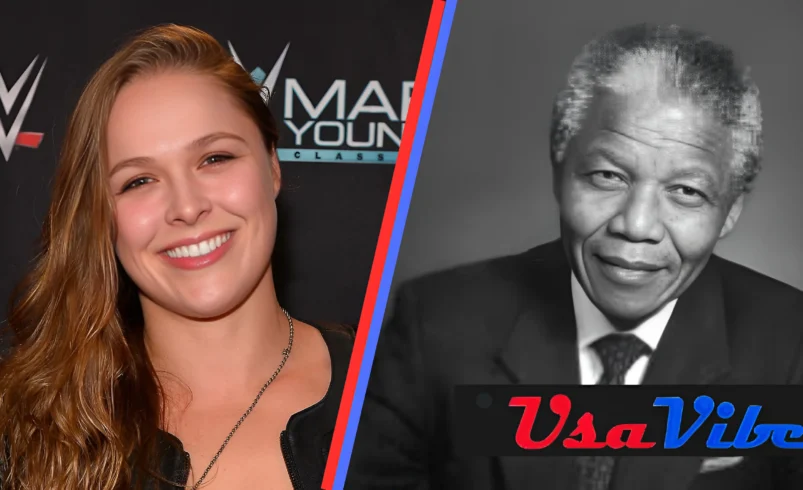
What could an American fighting champion and a South African freedom fighter possibly have in common?
At first glance, Ronda Rousey and Nelson Mandela seem to belong to completely different worlds. One became famous for defeating opponents inside combat sports arenas. The other spent decades challenging apartheid and eventually became South Africa’s first democratically elected president.
Their lives followed separate paths, shaped by different circumstances, ambitions, and responsibilities.
Yet their names sometimes appear together in online searches, raising an interesting question: Did Ronda Rousey and Nelson Mandela ever meet, work together, or share a personal connection?
The answer is less mysterious than some online discussions might suggest.
There is no reliable public evidence establishing a direct relationship between the two. However, examining their individual stories reveals fascinating differences in their experiences with determination, public pressure, personal sacrifice, and lasting influence.
Who Are Ronda Rousey and Nelson Mandela?
Ronda Rousey is an American former UFC champion, Olympic judoka, professional wrestler, and actress. Born on February 1, 1987, she became one of the most recognizable athletes in mixed martial arts history.
Nelson Mandela was a South African political leader, anti-apartheid activist, and Nobel Peace Prize recipient. Born on July 18, 1918, he spent 27 years imprisoned before helping guide South Africa toward democratic government.
Mandela died on December 5, 2013, at age 95.
Their achievements cannot be measured using the same standards. Rousey’s accomplishments belong primarily to competitive athletics and entertainment, while Mandela’s significance lies in political transformation and the struggle against institutionalized racial discrimination.
Understanding these distinctions is essential to appreciating their respective legacies.
Ronda Rousey’s Early Life and Fighting Background
Ronda Jean Rousey grew up in a family with a strong connection to martial arts.
Her mother, AnnMaria De Mars, was an accomplished judoka who became the first American woman to win a world judo championship.
That background introduced Rousey to an unusually demanding sporting environment.
She began training seriously at a young age and developed the discipline necessary to compete internationally.
Judo requires more than physical strength. Competitors must understand balance, timing, leverage, and an opponent’s movements.
Rousey’s aggressive fighting style eventually became one of her defining characteristics.
Her early career included considerable sacrifice as she pursued international competition.
Those efforts produced a historic achievement at the 2008 Beijing Olympics.
Her Historic Olympic Bronze Medal
At the 2008 Summer Olympics, Rousey won bronze in the women’s 70-kilogram judo division.
She became the first American woman to earn an Olympic medal in judo, an achievement that helped establish her reputation internationally.
The victory represented years of intensive training rather than a sudden breakthrough.
However, Olympic success did not immediately guarantee financial stability or celebrity status.
After leaving competitive judo, Rousey faced uncertainty about her future.
Eventually, she discovered an opportunity in mixed martial arts.
That decision changed her career dramatically.
How Ronda Rousey Changed Women’s MMA
When Rousey entered professional mixed martial arts, women’s participation in major organizations received considerably less attention than men’s competition.
Her performances helped change that situation.
Combining judo expertise with aggressive submission techniques, she quickly developed a reputation for ending fights decisively.
Her signature armbar became particularly recognizable.
Rousey won the Strikeforce women’s bantamweight championship before becoming the inaugural UFC women’s bantamweight champion.
In February 2013, she headlined UFC 157 against Liz Carmouche.
The event marked the first women’s fight in UFC history.
Rousey won by submission, establishing another milestone in her career.
Her success demonstrated that women’s MMA could attract major audiences, substantial media coverage, and commercial opportunities.
Although later defeats complicated her sporting reputation, they did not erase her contribution to the development of women’s combat sports.
Ronda Rousey’s Transition Into WWE and Entertainment
After her UFC career, Rousey expanded her professional activities into sports entertainment.
She made a prominent WWE appearance at WrestleMania 34 in 2018.
Her transition attracted considerable attention because professional wrestling requires a different combination of physical performance, storytelling, and audience interaction.
Rousey became Raw Women’s Champion and later held the SmackDown Women’s Championship.
She also appeared in films, including The Expendables 3 and Furious 7.
These projects introduced her to audiences who might not regularly follow combat sports.
Her career reflects the opportunities available to athletes who develop recognizable public identities beyond their original sporting disciplines.
However, her achievements have also been accompanied by criticism, including debates about some of her public statements and performances.
As with many prominent athletes, her legacy includes both accomplishments and controversies.
Nelson Mandela’s Childhood and Education
Nelson Rolihlahla Mandela was born in Mvezo, South Africa, in 1918.
He belonged to the Thembu royal family and grew up during an era when racial inequality shaped nearly every aspect of South African society.
Mandela attended educational institutions including the University of Fort Hare before pursuing legal studies.
His political awareness developed as he encountered discrimination and restrictions imposed upon Black South Africans.
In 1944, he joined the African National Congress and helped establish its Youth League.
The organization sought to challenge racial injustice and expand political rights.
Mandela initially participated in campaigns involving civil disobedience and organized resistance.
As government repression intensified, his political strategy evolved.
His growing involvement in the anti-apartheid movement eventually led to imprisonment and international recognition.
Nelson Mandela’s Struggle Against Apartheid
Apartheid was a system of institutionalized racial segregation enforced by South Africa’s white minority government.
Its policies restricted political participation, residential rights, employment opportunities, education, and freedom of movement for nonwhite communities.
Mandela became an influential figure within the African National Congress as opposition to these policies intensified.
Following the banning of the ANC in 1960, Mandela helped establish its armed wing, Umkhonto we Sizwe, in 1961.
The organization initially pursued sabotage against government infrastructure.
Mandela was arrested in 1962 and later prosecuted in the Rivonia Trial.
In June 1964, he and several other defendants received life sentences.
His imprisonment became one of the defining episodes of South Africa’s struggle against apartheid.
Twenty-Seven Years Behind Bars
Mandela spent much of his imprisonment on Robben Island.
Conditions were restrictive, and prisoners experienced hard labor and limitations on communication.
During those years, Mandela became an internationally recognized symbol of opposition to apartheid.
Campaigns demanding his release gained support around the world.
Despite enormous personal sacrifices, he remained involved in discussions concerning South Africa’s political future.
Mandela was released from prison on February 11, 1990.
His release marked a crucial turning point, but it did not immediately resolve the country’s political conflicts.
Negotiations, public pressure, and difficult compromises remained necessary.
How Nelson Mandela Became President
Following his release, Mandela played a leading role in negotiations to end apartheid and establish democratic elections.
In 1993, he shared the Nobel Peace Prize with South African President F. W. de Klerk for their contributions to the political transition.
South Africa held its first national democratic elections with universal adult suffrage in April 1994.
Mandela subsequently became the country’s first Black president.
He was inaugurated on May 10, 1994.
His presidency emphasized national reconciliation, democratic institutions, and efforts to address the consequences of apartheid.
However, South Africa continued facing severe economic inequality, poverty, and social divisions.
Mandela served one presidential term before stepping down in 1999.
His decision contributed to the country’s developing tradition of constitutional leadership transitions.
After leaving office, he remained involved in charitable activities, education, and HIV/AIDS awareness.
Did Ronda Rousey and Nelson Mandela Ever Meet?
There is no verified public record establishing that Ronda Rousey and Nelson Mandela personally met.
Neither their established biographies nor documented professional histories identify a meeting, joint appearance, formal collaboration, or personal relationship.
Their lives overlapped chronologically, but their careers developed in unrelated fields.
When Mandela died in December 2013, Rousey was already a prominent UFC champion.
That timing makes a meeting theoretically possible, but possibility is not evidence.
It would therefore be misleading to describe the two as friends, collaborators, or acquaintances without reliable documentation.
The connection most reasonably explored between them is thematic rather than personal.
What Do Ronda Rousey and Nelson Mandela Have in Common?
Their achievements differ enormously in historical context and social consequence.
Nevertheless, certain broad themes appear in both biographies.
Determination Under Pressure
Rousey faced intense competition while pursuing Olympic and professional fighting success.
Mandela endured imprisonment and political repression during his campaign against apartheid.
These circumstances should not be treated as equivalent.
However, both stories demonstrate how sustained commitment can shape a person’s public identity.
Challenging Established Barriers
Rousey helped expand opportunities for women in major mixed martial arts competitions.
Mandela participated in the political struggle against a system that denied fundamental rights to South Africa’s Black majority.
The scale and purpose of these struggles were fundamentally different.
Still, both became associated with significant changes within their respective fields.
International Recognition
Rousey’s athletic success brought international attention to women’s MMA.
Mandela became an internationally recognized political figure whose influence extended beyond South Africa.
Their public recognition emerged from different achievements, but both attracted audiences across national boundaries.
Why Their Legacies Matter Today
Rousey’s sporting legacy remains closely connected to the growth of women’s MMA.
Athletes entering professional combat sports today compete in an environment substantially different from the one she encountered.
Her visibility helped demonstrate the commercial potential of women’s competition.
Mandela’s legacy concerns South Africa’s transition from apartheid to democratic government.
His life remains central to discussions about civil rights, political imprisonment, negotiation, and reconciliation.
His birthday, July 18, is internationally recognized as Nelson Mandela International Day.
Understanding their legacies requires acknowledging both their achievements and the complexities of their histories.
Neither individual should be reduced to an inspirational slogan or an oversimplified comparison.
Frequently Asked Questions
Were Ronda Rousey and Nelson Mandela related?
No verified family connection exists between Ronda Rousey and Nelson Mandela.
Did Ronda Rousey ever meet Nelson Mandela?
There is no reliable public documentation confirming that they met.
What made Ronda Rousey famous?
She became famous through Olympic judo, her historic UFC championship career, and later appearances in WWE.
Why was Nelson Mandela imprisoned?
Mandela was imprisoned following his anti-apartheid activities and convictions arising from political resistance, including sabotage charges addressed during the Rivonia Trial.
Did Nelson Mandela win the Nobel Peace Prize?
Yes. He shared the 1993 Nobel Peace Prize with F. W. de Klerk.
Is Ronda Rousey still alive in 2026?
Yes. Ronda Rousey was born in 1987 and is 39 years old in November 2026.
When did Nelson Mandela die?
Nelson Mandela died on December 5, 2013, in Johannesburg, South Africa, at age 95.
Final Thoughts
Ronda Rousey and Nelson Mandela became influential figures for very different reasons.
Rousey changed expectations surrounding women’s participation in elite combat sports, while Mandela helped lead a historic political struggle against apartheid.
No verified personal or professional relationship connects them.
Their stories nevertheless provide opportunities to examine determination, institutional barriers, public responsibility, and the meaning of long-term influence.
The most meaningful way to understand their achievements is to recognize their differences rather than invent similarities.
One left an enduring mark on competitive athletics. The other helped reshape a nation’s political future.
Both remain recognizable historical figures, but their individual accomplishments deserve to be understood within their proper contexts.
Must Readable Posts for you;
Heather Locklear and Lorenzo Lamas: Romance Timeline 2026
Pamela Anderson and Liam Neeson: Their Romance Explained
Alix Earle and Braxton Berrios: Breakup & Reunion 2026