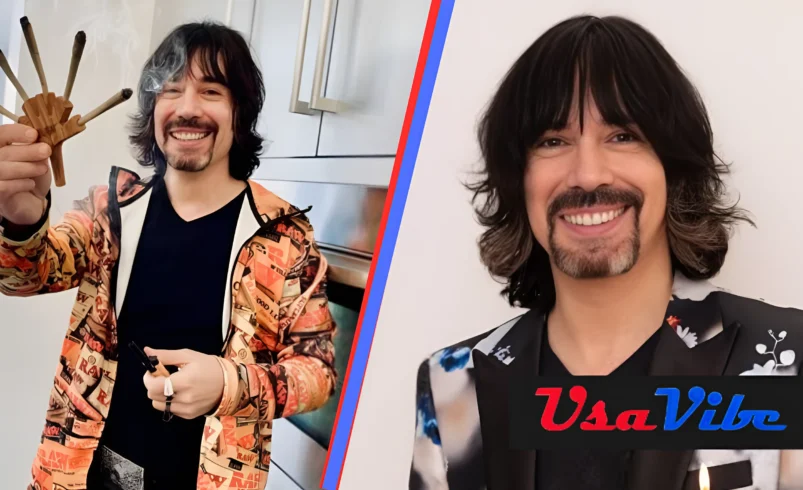
Josh Kesselman did not become wealthy by building a conventional technology company or selling a startup to a giant corporation.
His story started much smaller.
In 1993, Kesselman put roughly $500 into a small retail operation in Florida. He had a strong interest in rolling papers and specialty smoking products, but there was no obvious indication that the business would eventually grow into the international RAW brand.
More than three decades later, RAW is one of the most recognizable names in rolling papers, and Kesselman has expanded his business interests beyond the original product. He has also become the owner and publisher of High Times.
That naturally leads to the question people increasingly search for: What is Josh Kesselman’s net worth?
There is no publicly audited figure that answers that question.
Current websites give estimates ranging from tens of millions of dollars to around $200 million. The large difference between those numbers is not accidental. Kesselman’s major businesses are privately held, and the public does not have access to a complete breakdown of his personal assets, liabilities, ownership percentages or investments.
What can be established is the scale of the businesses he built and the unusual decision he made when a reported offer of approximately $500 million was put on the table.
Josh Kesselman Net Worth in 2026
Josh Kesselman’s exact net worth in 2026 is not publicly verified.
Online estimates vary substantially. Some recent publications place his wealth around $45 million to $80 million, while others estimate $100 million to $150 million or approximately $200 million.
Those numbers should be treated as estimates rather than established financial facts.
The reason is simple: RAW’s parent company is privately held. There is no public stock price that can be used to calculate Kesselman’s ownership stake, and there is no publicly available personal financial statement showing his assets and debts.
There is, however, one figure that gives some idea of the value others have placed on the business.
Kesselman’s own website says someone offered $500 million for the company and that he chose not to sell.
That does not mean Kesselman personally had $500 million in cash. It was an offer for the company, not a statement of his personal net worth.
That distinction is essential.
The $500 Million Offer Is the Most Interesting Financial Clue
The reported $500 million offer is one of the strongest publicly discussed indicators of the scale of Kesselman’s business.
According to Kesselman’s official biography, when he was asked about his net worth, he pointed to the fact that an offer of $500 million had been made for the company and said he still would not sell.
The New Yorker also reported in March 2026 that Kesselman declined to disclose RAW’s revenue figures, while noting that he had rejected a half-billion-dollar offer for RAW’s parent company, HBI Innovations.
That creates an important distinction between three different numbers:
Company offer: approximately $500 million
Company revenue: privately held and not fully disclosed
Josh Kesselman’s personal net worth: not publicly verified
Those three figures cannot simply be treated as interchangeable.
How Josh Kesselman Built His Wealth
Kesselman’s financial story goes back to a very modest beginning.
According to Inc., he started his business journey in 1993 with a $500 investment. He opened a smoke shop called Knuckleheads in Gainesville, Florida, after graduating from the University of Florida.
At that stage, Kesselman was selling specialty rolling papers, pipes, bongs and other smoking accessories.
The business eventually introduced him to European paper manufacturers, which helped set the stage for the product that would become RAW.
The transformation did not happen overnight.
Kesselman’s advantage was that he treated rolling papers as a product worth developing rather than as a commodity that customers would buy without caring about the details.
That approach became the foundation of RAW.
When RAW Rolling Papers Took Off
Kesselman launched RAW’s rolling-paper line in 2005.
The product differentiated itself through its unbleached and vegan positioning, and the brand developed a strong following in music and counterculture communities. The New Yorker reported that RAW gained significant traction within hip-hop and that its cultural visibility continued growing over the following years.
Forbes previously reported that RAW products were being sold in almost every country and described the business as having developed into a major global operation.
The company’s growth also became visible through retail-market data.
Inc. reported in 2018 that RAW had approximately 30% of the rolling-paper market in at least six states tracked by Flowhub, with Zig-Zag occupying the second position in those markets.
That kind of market presence helps explain why the company became considerably more valuable than the small Florida store where Kesselman’s business career began.
RAW Is Bigger Than Rolling Papers
One reason net-worth estimates vary is that RAW is not simply a single-paper product.
Kesselman’s business interests have included multiple brands and smoking accessories associated with HBI.
The broader product range has helped RAW develop from a rolling-paper label into a recognizable lifestyle brand.
That matters financially because a company can have value beyond the immediate sales of its best-known product.
Brand recognition, distribution relationships, intellectual property, product lines and customer loyalty can all influence the value of a privately held company.
But the exact value of those assets cannot be converted directly into Kesselman’s personal wealth without knowing how much of the business he owns and what liabilities exist.
HBI Is Central to the Net Worth Question
HBI is the company structure most closely associated with Kesselman’s business empire.
This is important because many online articles simply write “RAW is worth X” and then use that number as Kesselman’s personal fortune.
That is not how net worth works.
A founder’s personal wealth depends on their ownership stake in a business, plus other assets, minus liabilities.
For example, if a private company were worth $500 million, a person owning 50% would theoretically have a $250 million stake before considering taxes, debt and other factors. Someone owning 20% would have a very different financial position.
Without a verified ownership breakdown, calculating Kesselman’s exact personal wealth from the company’s estimated value is impossible.
How Much Revenue Does RAW Make?
This is another area where online articles tend to mix estimates with verified information.
A 2024 MarketWatch report described RAW as a business generating approximately $120 million in revenue and employing around 100 people in the United States.
Forbes reported an earlier estimate of approximately $200 million in annual global sales for Kesselman’s RAW-related empire.
These figures come from different years and sources, so they should not be combined into one supposed current revenue number.
More importantly, revenue is not profit.
A company selling $120 million worth of products does not give its owner $120 million in personal income.
Manufacturing, distribution, employees, marketing, taxes, inventory, legal expenses and other operating costs all affect the amount that eventually becomes profit.
Why Revenue Does Not Tell You Josh Kesselman’s Net Worth
This is one of the most important points when researching Kesselman’s finances.
Imagine a company reports $120 million in annual sales.
That sounds enormous, but the business might spend a substantial amount producing and distributing those products.
The remaining profit belongs to the company before considering how much is distributed to shareholders or reinvested.
Kesselman may also hold wealth in assets unrelated to RAW.
Therefore, using a company’s revenue as a shortcut for the founder’s net worth produces a misleading result.
This is why the large spread between online Josh Kesselman net-worth estimates should not be surprising.
His Business Philosophy Is Different From a Typical Exit
Kesselman’s decision not to accept the reported $500 million offer is particularly revealing about how he approaches ownership.
In interviews, he has repeatedly described the business as something driven by creativity and passion rather than simply maximizing an exit price.
Forbes quoted him discussing products that he makes even when they lose money because he enjoys creating them.
That philosophy is also visible in his approach to RAW’s unusual products.
The brand has produced novelty items, custom papers and unconventional smoking accessories that would not necessarily fit the traditional corporate-product model.
The strategy has helped make Kesselman himself part of the RAW identity.
Josh Kesselman and High Times
Kesselman’s business interests expanded again when he became the owner and publisher of High Times.
His official website says he acquired the publication with the goal of bringing it into a new era.
The New Yorker reported in 2026 that Kesselman was involved in efforts to revive the magazine after it stopped publishing in 2024.
The acquisition adds another business asset to his portfolio, although the terms of the transaction and its contribution to his personal wealth are not publicly detailed enough to calculate a new net-worth figure.
It does, however, show that Kesselman’s interests now extend beyond rolling papers.
His Wealth Is Also Connected to RAW’s Brand Value
One thing that separates Kesselman’s story from many small-business founders is the cultural value attached to RAW.
The company is not selling an unknown generic product.
RAW has developed a recognizable visual identity and a strong relationship with music, cannabis culture and younger consumers.
That kind of brand equity can be extremely valuable.
Forbes described RAW as a global business with a major cultural presence, while the 2026 New Yorker profile highlighted the brand’s continued visibility in music and cannabis culture.
A large part of the company’s value therefore comes from more than the physical paper itself.
Kesselman’s Philanthropy
Another part of Kesselman’s public profile is charitable giving.
His official website says that, through RAW, he has contributed more than $3 million in direct cash donations, along with approximately $200,000 in in-kind contributions, to various causes.
Those contributions have supported projects involving clean water, animal rescue, homelessness and environmental initiatives.
The donations should not be confused with personal net worth, but they provide additional context about how Kesselman has used the resources generated through the RAW business.
So, Is Josh Kesselman Worth $50 Million, $100 Million, or $200 Million?
There is currently no public evidence that allows one of those numbers to be presented as a confirmed fact.
Different websites have published different estimates.
Some place his wealth around $45 million to $80 million. Others use $100 million to $150 million. Another recent article simply gives an estimate of $200 million.
The more useful conclusion is that Kesselman appears to have built a very substantial private business fortune, while the exact size of his personal wealth remains unknown.
The reported $500 million offer is evidence that the business itself reached a very high valuation, but it does not establish how much money Kesselman personally owns.
Josh Kesselman’s Early Life and Career
Kesselman grew up in New York City and developed an interest in rolling papers at an early age.
In an interview with Forbes, he described a childhood memory involving his father and a rolling paper that helped spark his fascination with the product.
After attending the University of Florida, he began building his own retail business.
The early years were far removed from the financial scale of RAW today.
Inc. reported that Kesselman lived in a shed behind a friend’s home while getting his first business off the ground.
That period is important because it puts the later financial figures into perspective.
The business did not begin with a large investment fund or a wealthy corporate backer.
It started with a small retail operation and a founder who believed there was room to make rolling papers differently.
What Makes Josh Kesselman’s Story Financially Interesting?
The most interesting part of Kesselman’s financial story is not an exact number.
It is the way a relatively ordinary product became a global brand.
He entered a niche market, developed a distinctive product, built a recognizable identity around it and retained control while the company expanded internationally.
The decision not to sell after a reported $500 million offer is particularly significant because it means the wealth associated with the business has remained tied to private ownership rather than becoming a straightforward acquisition payout.
That also makes his net worth harder for outsiders to calculate.
Josh Kesselman Net Worth: The Bottom Line
Josh Kesselman’s exact net worth in 2026 is not publicly established.
Online estimates currently range widely, from approximately $45 million to $200 million or more. Those figures are based on assumptions about RAW’s value, business revenue, ownership and other assets rather than a publicly available personal financial statement.
What is documented is much more useful.
Kesselman started his entrepreneurial journey with a small $500 investment in 1993. He later built RAW into an internationally recognized rolling-paper brand, expanded HBI’s product portfolio, became involved with High Times, and reportedly declined an offer of around $500 million for the company.
RAW’s private ownership makes an exact personal net-worth calculation impossible from public information alone.
So if the question is “How much is Josh Kesselman worth?”, the responsible answer is that he is clearly a highly successful entrepreneur with a substantial private business fortune, but his precise personal net worth has not been publicly verified.
Frequently Asked Questions
What is Josh Kesselman’s net worth in 2026?
His exact net worth has not been publicly verified. Online estimates vary widely, with different publications placing him anywhere from tens of millions of dollars to around $200 million.
How did Josh Kesselman make his money?
The majority of his wealth is associated with the RAW rolling-paper business and the broader HBI operation. He started in retail and eventually built RAW into an international brand.
Did Josh Kesselman really turn down $500 million?
His official website says an offer of $500 million was made and that he declined to sell. The New Yorker also reported the half-billion-dollar offer in its 2026 profile.
Does Josh Kesselman own RAW?
Kesselman is the founder and central owner associated with RAW and HBI. However, the exact current ownership structure and percentage are not publicly disclosed in a way that permits a precise personal valuation.
How much does RAW make?
Public reports have cited different revenue figures at different points. MarketWatch reported approximately $120 million in revenue in 2024, while Forbes previously cited estimated annual global sales of around $200 million.
Does Josh Kesselman own High Times?
Yes. His official biography identifies him as the owner and publisher of High Times, and The New Yorker reported on his efforts to revive the publication in 2026.
Read More: Usa Vibe