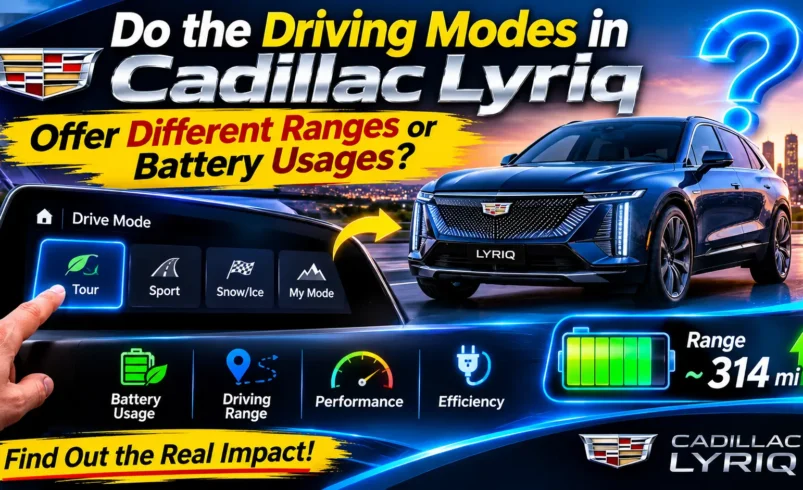
The Cadillac LYRIQ offers different driving modes that allow drivers to customize how their electric SUV responds to road conditions and personal preferences. These modes include Tour, Sport, Snow/Ice, and My Mode, although availability can vary depending on the model year, trim, and equipment. One common question among LYRIQ owners is whether selecting a different driving mode changes the vehicle’s electric range or causes the battery to drain faster.
The short answer is that the driving modes do not change the battery’s physical capacity or provide separate official range ratings. However, they can influence how the vehicle delivers power, responds to accelerator inputs, and manages traction. These changes can indirectly affect energy consumption during everyday driving. For example, Sport Mode can encourage more aggressive acceleration, while Tour Mode is designed to provide a smoother everyday driving experience.
Understanding how each mode works can help drivers make better decisions about efficiency, comfort, and performance. The actual distance a LYRIQ travels on a full charge also depends on factors such as driving speed, outside temperature, road conditions, tire pressure, and climate-control settings.
Do Cadillac LYRIQ Driving Modes Change Battery Range?
Cadillac does not publish separate official driving-range estimates for Tour, Sport, Snow/Ice, and My Mode. Selecting a different mode does not increase or decrease the battery’s rated capacity. Instead, each mode changes particular vehicle settings that influence the driving experience.
For example, Sport Mode adjusts accelerator response and other performance characteristics, while Snow/Ice Mode modifies pedal tuning and traction-related systems. These adjustments can influence how efficiently energy is used, particularly when road conditions or driving habits change.
Tour Mode is generally a sensible choice for everyday driving because it provides smooth acceleration and balanced handling. However, selecting Tour Mode does not automatically guarantee the longest possible range. A driver traveling at high highway speeds in Tour Mode may use more energy than someone driving smoothly in Sport Mode at a lower speed.
The important distinction is between the vehicle’s official range rating and its real-world energy consumption. Driving modes influence the latter indirectly rather than changing the battery’s underlying capacity.
How Each Cadillac LYRIQ Driving Mode Affects Battery Usage
Each driving mode serves a different purpose. Understanding its characteristics helps drivers choose the appropriate setting without unnecessarily sacrificing efficiency.
1. Tour Mode: Balanced Driving and Everyday Efficiency
Tour Mode is the standard everyday driving setting for the Cadillac LYRIQ. It is designed to provide a comfortable balance between acceleration, steering response, and overall driving behavior.
For drivers interested in conserving battery energy, Tour Mode is often a practical starting point. Its smoother driving characteristics can make it easier to avoid unnecessary acceleration and maintain consistent speed.
This can be particularly useful during daily commutes, city driving, and longer highway journeys. Smooth acceleration and gradual changes in speed generally help electric vehicles use energy more efficiently.
Tour Mode does not have a separate guaranteed maximum-range rating, but it offers a comfortable environment for drivers who prioritize predictable everyday performance.
2. Sport Mode: More Responsive Performance
Sport Mode changes the LYRIQ’s driving characteristics to provide a more responsive and engaging experience.
Depending on the vehicle’s configuration, it modifies steering effort, accelerator pedal tuning, electric vehicle sound enhancement, and suspension settings when equipped. It is intended to improve handling and acceleration on dry pavement.
Sport Mode can contribute to higher battery consumption when drivers frequently take advantage of its sharper acceleration response. Rapid acceleration requires substantial electrical power, and repeated high-power driving can reduce the distance available from a charge.
However, simply activating Sport Mode does not mean the battery will immediately drain faster. Driving behavior remains a major factor. A driver using Sport Mode gently and maintaining a steady speed may achieve better efficiency than someone using Tour Mode aggressively.
3. Snow/Ice Mode: Traction and Slippery Road Conditions
Snow/Ice Mode is designed for driving on slippery surfaces where maintaining traction is more important than delivering maximum acceleration.
The system adjusts accelerator pedal tuning to help optimize traction and modifies electric all-wheel-drive and steering behavior where equipped.
This mode can help reduce unwanted wheel spin when accelerating on snow-covered or icy roads. Its purpose is to provide more controlled vehicle behavior rather than maximize driving range.
Battery consumption may vary depending on the conditions. Cold temperatures, slippery surfaces, and additional traction demands can all influence energy use.
It is important to remember that Snow/Ice Mode is not intended to free a vehicle that is already stuck in snow, sand, mud, or gravel.
4. My Mode: Personalized Driving and Energy Consumption
My Mode allows LYRIQ drivers to customize selected vehicle characteristics according to their preferences.
Depending on the vehicle’s equipment, customization options may include acceleration feel, brake feel, steering, suspension, and motor sound.
For example, a driver can select a more relaxed acceleration feel while keeping preferred steering settings. This creates an opportunity to develop a comfortable driving configuration without using every performance-oriented setting.
Drivers interested in efficiency can experiment with smoother acceleration characteristics and consistent driving habits. However, My Mode does not provide a guaranteed battery-saving setting or a separate official range rating.
Its primary purpose is personalization, allowing drivers to balance comfort, responsiveness, and handling.
Does Sport Mode Drain the Cadillac LYRIQ Battery Faster?
Sport Mode can increase battery consumption when it encourages more aggressive driving. The LYRIQ is an electric SUV capable of delivering substantial torque, and repeated hard acceleration requires considerable energy from its battery.
When a driver accelerates quickly, the electric motors draw more power to produce the requested performance. Repeating this behavior throughout a journey can reduce overall efficiency.
However, the relationship between Sport Mode and battery consumption is not automatic. The vehicle does not necessarily consume significantly more energy simply because the Sport setting is active.
Speed, acceleration frequency, road conditions, and driving habits remain important considerations. Maintaining a steady speed and avoiding unnecessary high-power acceleration can help preserve range regardless of the selected driving mode.
Does Regenerative Braking Improve Battery Efficiency?
Regenerative braking is an important feature of the Cadillac LYRIQ because it allows the vehicle to recover some energy during deceleration.
When the driver slows down, the electric motor can operate as a generator, converting some of the vehicle’s movement into electrical energy that returns to the propulsion battery.
The LYRIQ also provides Regen on Demand, which allows drivers to request regenerative deceleration using the steering-wheel paddle.
This feature can be particularly useful in traffic situations where frequent slowing is necessary.
However, regenerative braking does not recover all the energy used during acceleration. Some energy is always lost through heat, friction, and other operating processes.
Regenerative braking may also be limited when the battery is nearly fully charged or particularly cold. Drivers should therefore not assume that regeneration will always operate at its maximum level.
One-Pedal Driving and Regen on Demand are separate features from the four main driving modes and should be considered when evaluating the LYRIQ’s energy efficiency.
What Other Factors Affect Cadillac LYRIQ Driving Range?
Driving mode is only one part of the overall efficiency equation. Several other factors can have a greater influence on how far the LYRIQ travels between charging sessions.
Driving speed: Highway driving at higher speeds generally requires more energy because aerodynamic resistance increases as speed rises.
Outside temperature: Cold weather can reduce battery efficiency and increase the energy required to heat the cabin. Extremely hot weather can also increase cooling demands.
Climate control: Heating and air conditioning use electricity that would otherwise be available for driving.
Tire pressure: Incorrect tire pressure can increase rolling resistance and negatively affect energy consumption.
Vehicle load: Carrying additional passengers, luggage, or equipment can increase the energy required to move the vehicle.
Road conditions: Hills, rough surfaces, heavy traffic, and frequent acceleration can all influence battery usage.
Considering these factors is essential because a driver may experience different ranges on two journeys even when using exactly the same driving mode.
Which Cadillac LYRIQ Driving Mode Is Best for Maximum Range?
For everyday efficiency, Tour Mode is a sensible default because it provides smooth and balanced driving characteristics. Drivers who want to prioritize comfort and predictable acceleration may find it particularly suitable.
My Mode is another option for people who prefer to personalize their driving experience. Choosing relaxed acceleration characteristics may help encourage smoother driving.
Sport Mode is better suited to situations where more responsive performance is desired, while Snow/Ice Mode should be selected when slippery road conditions require additional traction management.
Ultimately, no driving mode guarantees maximum range. Consistent speed, gentle acceleration, appropriate tire pressure, and effective climate-control management are more important than simply selecting one setting and expecting a specific mileage improvement.
Closing Thoughts
The Cadillac LYRIQ’s driving modes offer different performance characteristics, but they do not provide separate official battery-range ratings or change the vehicle’s underlying battery capacity.
Tour Mode provides balanced everyday driving, Sport Mode offers more responsive performance, Snow/Ice Mode helps manage slippery conditions, and My Mode allows drivers to personalize selected vehicle settings.
These differences can indirectly influence battery consumption, particularly when they change acceleration behavior or encourage different driving habits. However, factors such as speed, weather, climate control, road conditions, and regenerative braking also play important roles.
For drivers who want to make the most of their LYRIQ’s electric range, smooth acceleration and consistent driving habits are generally more useful than relying on a particular driving mode alone.
Frequently Asked Questions
1. Do Cadillac LYRIQ driving modes offer different battery ranges?
No. Cadillac does not publish separate official range ratings for each driving mode. However, different settings can indirectly influence real-world energy consumption through changes in acceleration response and vehicle behavior.
2. Which Cadillac LYRIQ driving mode offers the best efficiency?
Tour Mode is a practical choice for everyday efficiency because it provides smooth, balanced driving. However, actual range depends more broadly on speed, acceleration, temperature, and driving conditions.
3. Does Sport Mode reduce Cadillac LYRIQ range?
Sport Mode can contribute to higher energy consumption when drivers frequently use its more responsive acceleration. However, selecting Sport Mode alone does not guarantee a noticeable reduction in range.
4. Does Snow/Ice Mode use more battery power?
Battery consumption depends on road conditions, temperature, and driving behavior. Snow/Ice Mode prioritizes traction and controlled acceleration rather than maximizing range.
5. Can regenerative braking increase Cadillac LYRIQ driving range?
Regenerative braking recovers some energy during deceleration and returns it to the battery. It can improve overall efficiency, particularly in stop-and-go traffic, although it cannot recover all previously used energy.
Also Read:
Xnañga: Meaning, Website Connection and What You Should Know