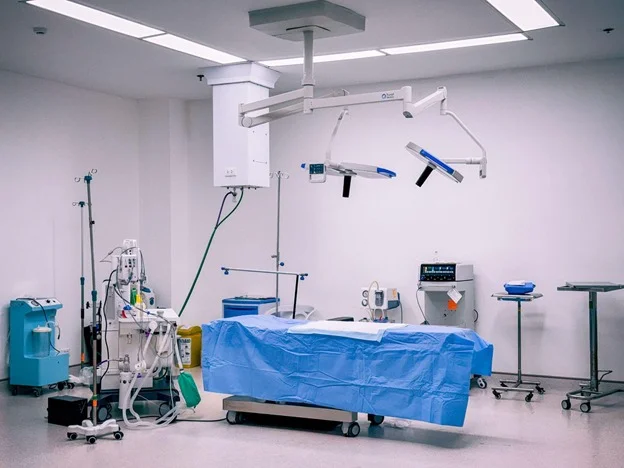
Fifty years ago, pointing a beam of light at someone to fix their vision or destroy a tumor was strictly the domain of science fiction. Now it’s something that happens in outpatient clinics on a Tuesday. The path from there to here is a genuinely odd story – and worth understanding, particularly if you or someone close to you might one day be on the receiving end of one of these procedures.
How Did Laser Technology Begin?
It starts, as a lot of things do, with Einstein. In 1917, he worked out the theory of stimulated emission of radiation. Then the idea mostly sat there for the better part of four decades. Theodore Maiman built the first functioning laser in 1960, using a synthetic ruby crystal, and showed that light could actually be focused and controlled with real precision.
Science fiction had already made up its mind about what lasers were for – vaporizing things, mostly. Spaceships, enemies, the occasional city. The pop culture version was loud and wildly off the mark. Quietly, in the background, researchers were asking a more practical question: could focused light do what a scalpel does, but better?
When Did Lasers Enter Medicine?
The first medical uses appeared in the 1960s-ophthalmology and dermatology mainly, where precision really mattered, and conventional instruments had limits. Early adopters took some professional heat for it. Skepticism from colleagues, slow-moving regulators, equipment that was unwieldy and expensive, and not always cooperative.
But enough procedures held up well enough that attitudes started shifting. Safety protocols caught up. It wasn’t clean progress. Just progress.
What Changed During the Technological Revolution?
The 1990s and 2000s are when the pace picked up. Improved wavelength control meant surgeons could target specific tissue without as much collateral damage – which pulled in cardiology, oncology, and urology, fields that hadn’t previously had much use for any of this.
Lasers also started working alongside imaging systems, giving surgeons visual feedback in real time during a procedure. That opened things up considerably. Costs came down too, and laser surgery stopped being something only major research hospitals could offer. More clinics, more patients, less mystique.
Where Does Laser Surgery Stand Today?
The current direction is restraint-smaller incisions, less bleeding, faster recovery. Robotic-assisted systems have pushed accuracy further than unassisted hands can reliably go, which matters most when the target area leaves little room for error.
Vision correction is probably the most well-known example. The SMILE procedure eye surgery- – Small Incision Lenticule Extraction – uses a femtosecond laser to reshape the cornea through a tiny incision, and recovery tends to be quicker than LASIK for many patients. In oncology, lasers are doing real work targeting tumors while mostly sparing the surrounding tissue. Cosmetic applications – scar reduction, skin resurfacing – have expanded too. All of it goes through the FDA or equivalent regulatory bodies before it reaches clinical use.
What This Means If You’re Considering a Procedure
If you’re looking at a laser-based treatment-vision correction, a skin issue, something more complex – it helps to know this isn’t new. Six decades of development, refinement, clinical feedback, and adjustment. The technology has had time to mature. Ask your doctor which specific technique fits your situation, and how long that particular approach has been in regular use. The science fiction backstory is a fun footnote. The actual story is quieter – methodical work, accumulated over years, mostly without anyone paying much attention.