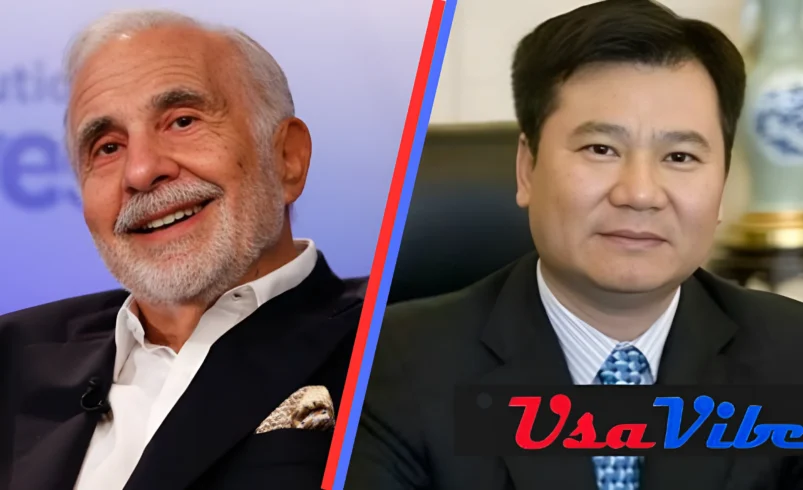
The business world is shaped by individuals who recognize opportunities before others see their potential. Some build companies from the ground up, while others create influence by investing in established businesses and challenging the way they operate. Carl Icahn and Zhang Jindong represent two distinct approaches to building wealth and exercising corporate influence.
Carl Icahn is an American billionaire investor widely associated with shareholder activism, corporate restructuring, and high-profile investment campaigns. Zhang Jindong, on the other hand, built his reputation in China through Suning, a retail business that expanded into a major commercial group with interests extending beyond traditional stores.
Although both names are associated with large-scale business decisions, their careers developed in different markets and under different circumstances. There is no widely documented direct business partnership between the two. Their stories are interesting to examine together because they demonstrate how different business philosophies can shape companies, industries, and international investment activity.
Understanding their individual journeys provides a broader perspective on how business influence is created, maintained, and sometimes challenged.
Carl Icahn: The Investor Who Made Corporate Boardrooms Pay Attention
Born on February 16, 1936, in New York City, Carl Icahn developed an interest in financial markets that eventually made him one of America’s best-known activist investors.
He graduated from Princeton University in 1957 with a degree in philosophy. After briefly attending medical school, he moved toward the financial industry and began working on Wall Street in 1961.
His career took a major step forward in 1968 when he established Icahn & Co., a securities firm specializing in arbitrage and options trading. Over the following decade, he shifted toward acquiring substantial positions in individual companies.
Icahn’s investment philosophy differed from that of investors who simply purchased shares and waited for their value to increase. He often targeted businesses where he believed changes in management, financial decisions, or corporate structure could unlock additional shareholder value.
This approach brought him into disputes and negotiations involving some of America’s most recognizable companies. His involvement with businesses such as Apple, eBay, Motorola, Netflix, and Revlon helped establish his reputation in the investment community.
His career also attracted criticism, particularly around aggressive corporate campaigns and the financial consequences of certain transactions. Nevertheless, shareholder activism became closely associated with his name.
Zhang Jindong: From a Small Appliance Store to a Retail Empire
Zhang Jindong’s journey began in a completely different business environment.
In 1990, he established an air-conditioner retail business in Nanjing, China. His initial operation was a modest store, but he recognized that Chinese consumers were becoming increasingly interested in household appliances.
Rather than limiting the business to a single location, Zhang developed a model built around product availability, customer service, delivery, installation, and maintenance. These services helped Suning establish a competitive position in the local market.
As demand increased, the company expanded into other Chinese cities and gradually developed into a major national retailer.
A significant milestone came in 2004, when Suning’s retail business became publicly listed in Shenzhen. This provided a foundation for further expansion and strengthened its position in China’s growing consumer market.
Zhang eventually became associated with one of the country’s most recognizable retail groups. His ambitions extended beyond selling household appliances. He wanted Suning to become a business capable of combining physical stores, online shopping, logistics, and digital technology.
Two Business Philosophies Built Around Different Opportunities
Although Carl Icahn and Zhang Jindong operated in different industries, their careers reveal an interesting contrast in how business influence can be developed.
Icahn focused heavily on financial ownership and corporate decision-making. His approach often involved identifying companies where he believed management or organizational changes could improve business performance.
Zhang concentrated on building an operating company. His strategy involved expanding distribution, understanding consumer behavior, developing retail infrastructure, and responding to changes in shopping habits.
Their approaches can be understood through several differences:
- Primary business focus: Icahn became known for investment management and shareholder activism, while Zhang built his reputation in retail and commercial operations.
- Market environment: Icahn’s career developed primarily in American financial markets, whereas Zhang built his business in China’s rapidly changing consumer economy.
- Growth strategy: Icahn often sought opportunities through company ownership and restructuring. Zhang pursued expansion through stores, partnerships, logistics, and digital retail.
- Business influence: Icahn frequently influenced corporate boards and management decisions, while Zhang exercised influence through the companies and commercial networks he established.
Neither career followed a simple path. Both demonstrate how business leaders can use different resources and strategies to create substantial influence.
The Suning Transformation: Zhang’s Ambition to Connect Online and Offline Shopping
One of Zhang’s most significant business challenges was adapting Suning to the growth of e-commerce.
Traditional retail had helped the company expand across China, but the arrival of online shopping changed customer expectations. Consumers increasingly wanted to compare products, place orders digitally, and receive purchases without visiting a physical store.
Zhang recognized that relying exclusively on traditional retail would limit Suning’s future opportunities.
In 2010, Suning launched its online shopping platform, Suning.com. This marked an important stage in the company’s transition toward an integrated retail model.
The broader ambition was to connect several parts of the shopping experience:
- Physical stores where customers could examine products.
- Online platforms for convenient product discovery and ordering.
- Logistics networks supporting delivery and distribution.
- Technology systems helping the company understand purchasing patterns.
- Customer services connecting digital and physical retail experiences.
The transition was ambitious, but it also created significant operational challenges. Suning had to compete with online-focused businesses while managing the costs associated with its existing physical retail network.
Its strategic partnership with Alibaba in 2015 represented another important development, bringing together two major businesses with complementary commercial interests.
Carl Icahn’s Approach to Corporate Influence
While Zhang was transforming a retail business, Icahn was continuing to pursue opportunities across multiple industries.
His investment activities became particularly recognizable through campaigns involving corporate governance, shareholder rights, management accountability, and company restructuring.
One of the defining characteristics of his approach was the willingness to challenge established management teams.
An activist investor may believe that a company’s existing leadership is not making the best decisions for shareholders. Rather than immediately selling the investment, the investor can use ownership rights to advocate for changes.
These efforts can include:
- Requesting changes to corporate strategy.
- Challenging executive compensation arrangements.
- Seeking representation on company boards.
- Encouraging asset sales or business separations.
- Advocating for improved capital allocation.
Icahn used several of these approaches throughout his career. His influence extended across sectors including energy, telecommunications, manufacturing, technology, and consumer businesses.
His investment vehicle, Icahn Enterprises, became the central structure through which many of his business interests were managed.
Zhang Jindong’s International Ambitions and the Inter Milan Chapter
Zhang’s business interests eventually extended beyond China’s retail market and into international sports.
In June 2016, Suning acquired a majority stake in Italian football club Inter Milan. The acquisition represented a major international investment and gave the Chinese group a prominent position in European football.
The move was intended to increase Suning’s international visibility while connecting its commercial ambitions with the global popularity of football.
Zhang’s son, Zhang Kangyang, also known as Steven Zhang, became closely involved in the club’s management and later served as its president.
Under Suning’s ownership, Inter won important domestic competitions, including Serie A titles. However, the investment also became connected with the financial pressures facing the wider Suning business.
In May 2024, Oaktree Capital Management took control of Inter after Suning failed to repay a €395 million loan secured against its ownership stake.
This development marked the end of Suning’s control of the Italian club, despite its sporting achievements during the ownership period.
The Inter Milan experience illustrates how international investments can offer commercial visibility while also introducing financial and operational risks.
What Actually Connects Carl Icahn and Zhang Jindong?
The first thing worth understanding is that Carl Icahn and Zhang Jindong are not widely documented business partners, relatives, or participants in a shared corporate venture.
Their names are better understood through a comparison of their business careers.
Both became influential figures through their involvement in large commercial organizations, but the nature of their influence was different.
Icahn built his reputation by investing in companies and advocating changes that he believed could improve their financial performance. Zhang established and expanded a retail organization that became a significant participant in China’s consumer economy.
Their experiences also demonstrate how business decisions are shaped by market conditions. American corporate investment operates within a different financial and regulatory environment from China’s retail sector.
Comparing the two therefore provides an opportunity to understand different approaches to ownership, expansion, leadership, and risk without assuming that they have a direct personal or professional connection.
Business Lessons Hidden in Their Different Journeys
The careers of Icahn and Zhang offer several useful observations for entrepreneurs, investors, and business students.
Recognizing an opportunity matters. Zhang identified demand for household appliances at a time when China’s consumer market was developing rapidly. Icahn built his investment career around identifying companies where he believed corporate changes could create value.
Growth requires adaptation. Suning’s move toward online retail demonstrated the importance of responding to changing consumer behavior. Similarly, investors must continuously reassess companies as markets and business conditions evolve.
Expansion introduces new risks. Building a large organization can create opportunities, but debt, operating expenses, competition, and market changes can affect long-term stability.
Leadership involves difficult decisions. Both careers illustrate how business leaders must make decisions that can influence employees, investors, customers, and other stakeholders.
These observations are relevant beyond the careers of two individual businessmen. They reflect challenges that businesses across different countries and industries continue to face.
Final Thoughts: Two Different Paths Through the World of Business
Carl Icahn and Zhang Jindong represent two distinct approaches to commercial success. One became known for influencing companies through investments and shareholder activism, while the other built a major retail organization through expansion, customer services, and technological transformation.
Their stories also include setbacks and difficult decisions. Icahn’s investment career has involved significant corporate disputes and financial scrutiny, while Zhang’s ambitions faced serious challenges as Suning encountered financial pressure and eventually lost control of Inter Milan.
There is no established direct partnership between the two, but examining their careers together offers an interesting look at how business influence develops in different economic environments.
Also Read:
Brian Roberts and Edward Roski Jr: Business Empires, Net Worth, and Their Connection
Lachlan Murdoch and Oliver Zipse: Careers, Leadership, and Business Influence in 2026