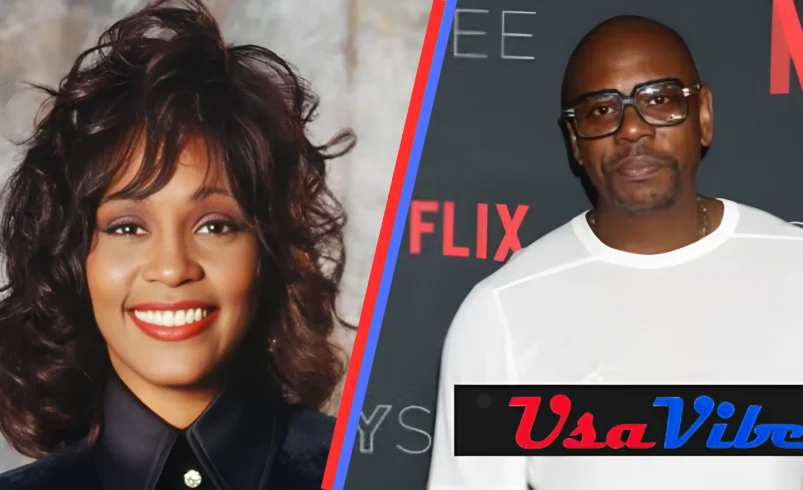
Few entertainers have influenced American popular culture as powerfully, or as differently, as Whitney Houston and Dave Chappelle. Houston could hold an arena silent with a single sustained note. Chappelle could make a crowded theater laugh, then turn that laughter into an uncomfortable question about society.
Their names occasionally appear together in online searches, prompting curiosity about a possible friendship, collaboration, or shared history. Yet their documented careers tell two separate stories. There is no reliable public evidence establishing a personal relationship or professional partnership between them.
What connects their stories is something broader: both became recognizable voices in Black American entertainment while navigating the expectations, commercial pressures, and public scrutiny that accompany extraordinary fame. Examining their achievements side by side reveals how music and comedy can shape culture in dramatically different ways.
Who Were Whitney Houston and Dave Chappelle?
Whitney Houston was an American singer and actress celebrated for her exceptional vocal control, emotional performances, and commercial success. Born on August 9, 1963, in Newark, New Jersey, she emerged as an international recording star during the 1980s. She died on February 11, 2012, in Beverly Hills, California.
Dave Chappelle, born August 24, 1973, in Washington, DC, is an American standup comedian, actor, writer, and producer. He became especially famous through Chappelle’s Show, the influential sketch comedy series that premiered in 2003.
Houston’s primary instrument was her voice. Chappelle’s is his perspective, delivered through storytelling, timing, impersonation, and satire. Both developed styles that audiences could identify within seconds, even when their material changed.
Whitney Houston’s Journey From Church Choir to Global Stardom
Houston grew up surrounded by accomplished musicians. Her mother, Cissy Houston, was a respected gospel and soul vocalist, while Dionne Warwick was her cousin. Music was not merely an extracurricular activity in her childhood; it was woven into family life.
She sang at New Hope Baptist Church in Newark and gained early experience performing and recording backing vocals. Before becoming an international superstar, she also worked as a model, an unusual crossover that helped introduce her to broader audiences.
Record executive Clive Davis signed Houston to Arista Records in 1983. Her self titled debut album arrived in 1985, introducing a voice that combined gospel rooted intensity with accessible pop arrangements.
Songs including Saving All My Love for You, How Will I Know, and Greatest Love of All demonstrated different sides of her ability. She could make a ballad feel intimate, then approach an upbeat track with effortless energy.
Her second album, Whitney, debuted at number one on the Billboard 200 in 1987. She eventually became the first artist to achieve seven consecutive number one singles on the Billboard Hot 100, an achievement that established her position in recording history.
Why Houston’s Voice Remains So Important
Many successful performers possess strong voices. Houston distinguished herself through the precision with which she used hers. Her phrasing, breath control, dynamic range, and ability to build emotional tension made difficult passages sound remarkably natural.
Listen closely to her most celebrated recordings and the technical accomplishment becomes apparent. Quiet verses often establish the story before the chorus rises toward a dramatic peak. She could shift from delicate restraint to astonishing power without losing clarity.
That balance influenced generations of singers. Her performances became reference points for vocal competitions, church musicians, and aspiring recording artists. Imitating the notes is one challenge; communicating the feeling behind them is another.
Houston’s 1992 recording of I Will Always Love You for The Bodyguard remains one of her defining achievements. Originally written and recorded by Dolly Parton, the song acquired a different emotional scale through Houston’s interpretation.
The film also demonstrated her appeal beyond the recording studio. Starring opposite Kevin Costner, she brought an established superstar’s presence to her first major film role. Later projects included Waiting to Exhale and The Preacher’s Wife.
Dave Chappelle’s Early Career and Breakthrough
Chappelle’s route to recognition looked nothing like Houston’s. Raised partly in Washington and Ohio, he developed an interest in comedy while still young. He attended Duke Ellington School of the Arts and performed standup as a teenager.
Comedy clubs provided a demanding education. Unlike polished recordings, standup exposes performers to an immediate audience response. A joke either lands or it does not, and every silence becomes part of the lesson.
Chappelle appeared in the 1993 comedy Robin Hood: Men in Tights and later worked in films including The Nutty Professor, Con Air, and You’ve Got Mail. He also co wrote and starred in the 1998 comedy Half Baked.
Created with Neal Brennan, the Comedy Central series blended sketches, pop culture references, race related satire, and musical guests. Its memorable characters became conversational shorthand for audiences who quoted and replayed their favorite scenes.
The show established Chappelle as an unusually influential television comedian, but its success also brought intense pressure. He departed during production of its third season in 2005, leaving one of television comedy’s most discussed unfinished runs.
What Made Chappelle’s Comedy Distinctive?
Chappelle’s work often begins with something familiar: a social ritual, a celebrity image, an everyday misunderstanding. He then changes the angle until viewers are forced to reconsider assumptions behind the original situation.
His delivery matters as much as the writing. He frequently uses pauses, shifts in tone, and carefully controlled expressions to create suspense. The punchline becomes more effective because the audience senses that the story could move in several directions.
Race, celebrity, wealth, media representation, and freedom of expression have appeared repeatedly in his material. His approach has won admirers who value provocative comedy, while some routines have also drawn substantial criticism for their treatment of marginalized groups.
Recognizing both responses is essential to understanding his public legacy. Comedy can challenge accepted ideas, but audiences may reasonably disagree about whether particular jokes illuminate a subject or cause harm.
Chappelle later returned prominently to standup and released multiple specials. He received the Mark Twain Prize for American Humor in 2019, recognition of his impact on the form.
Did Whitney Houston and Dave Chappelle Ever Work Together?
No verified film, album, television production, or comedy special establishes a direct collaboration between Houston and Chappelle. Reliable biographical accounts also do not document a close friendship or family connection.
Their careers overlapped chronologically. Houston was already a superstar when Chappelle began appearing in films, and both occupied prominent places in entertainment during the early 2000s. Overlap, however, should not be confused with an actual meeting or partnership.
The most accurate answer is therefore straightforward: Whitney Houston and Dave Chappelle were influential entertainers whose professional paths were distinct. Claims about a private friendship, feud, romance, or joint project require evidence that has not been reliably established.
Two Different Relationships With Fame
Houston became a global star during an era when record labels, radio programmers, television appearances, and physical album sales shaped mainstream celebrity. Her image was carefully presented, and expectations surrounding her voice and public persona were enormous.
Chappelle became famous in an increasingly fragmented media environment. Cable television accelerated his popularity, while later streaming platforms gave his standup performances new audiences across generations.
Both experienced the difficulty of being understood through a public image. Houston’s personal struggles were frequently covered by tabloids, sometimes overshadowing serious discussion of her artistic achievements. Chappelle’s decisions and controversial performances likewise became major news stories, often generating debate beyond comedy itself.
Neither person’s life can be reduced to those headlines. Their work deserves examination on its own terms, with space for criticism, context, and the complexity of individual circumstances.
Music, Comedy, and Black Cultural Expression
Houston and Chappelle also belong to a much larger history of Black artists changing mainstream American entertainment.
Houston brought gospel influenced vocal traditions to global pop audiences. Her chart success helped challenge assumptions about which performers could dominate commercial radio and international music markets.
Chappelle used sketch comedy and standup to explore racial stereotypes, social contradictions, and the entertainment industry’s treatment of Black performers. His work drew from earlier traditions of observational and confrontational comedy while developing a recognizable voice of its own.
Their methods were different, but both reached audiences far beyond the communities and creative traditions that shaped them. Houston’s recordings traveled across languages and generations. Chappelle’s routines circulated through television broadcasts, recordings, online clips, and everyday conversation.
Cultural influence is not simply a matter of sales or awards. It also involves what later artists imitate, debate, reject, or transform. On that measure, both figures remain important subjects for understanding American popular culture.
Whitney Houston’s Final Years and Enduring Legacy
Houston’s later career included the 2009 album I Look to You, which debuted at number one on the Billboard 200. The project reflected her desire to return to recording after years of intense public attention surrounding her personal life.
She died in 2012 at age 48. Authorities determined that the immediate cause was accidental drowning, with heart disease and cocaine use contributing to her death.
Her passing prompted widespread mourning, but her artistic legacy continued to grow. She was inducted into the Rock and Roll Hall of Fame in 2020 and received a Recording Academy Lifetime Achievement Award in 2026.
Her recordings remain central to discussions about popular singing, particularly the relationship between technical mastery and emotional communication.
The strongest tribute to Houston is not endless speculation about her private life. It is listening carefully to the music and acknowledging how much skill went into making those performances unforgettable.
Dave Chappelle’s Continuing Influence
Unlike Houston, whose recorded catalog is complete, Chappelle has continued developing his work in public. His standup career expanded through tours, appearances, and streaming specials after his return to the spotlight.
His performances remain capable of producing admiration and sharp disagreement. Some audiences view his willingness to approach sensitive topics as essential to comedy. Others object to specific jokes and question their consequences for the people discussed.
Those disagreements form part of the contemporary conversation about artistic freedom, accountability, and the responsibilities that accompany a large public platform.
Whatever one’s assessment of individual routines, Chappelle’s influence on sketch comedy and modern standup is widely recognized. His early television work helped shape how a generation understood the possibilities of satire on cable television.
Frequently Asked Questions
Were Whitney Houston and Dave Chappelle friends?
No reliable public documentation confirms a close friendship. Their entertainment careers overlapped, but that alone does not establish a personal relationship.
Did Dave Chappelle perform with Whitney Houston?
There is no verified record of a joint musical performance or formally credited entertainment project featuring both artists.
Was Whitney Houston older than Dave Chappelle?
Yes. Houston was born in August 1963, while Chappelle was born in August 1973, making her approximately ten years older.
What is Whitney Houston best remembered for?
She is remembered for her extraordinary singing voice, commercially successful recordings, influential performances, and starring roles in films such as The Bodyguard.
Why is Dave Chappelle famous?
He is known for standup comedy, acting, and Chappelle’s Show, which became a defining sketch comedy series of the early 2000s.
Did they receive major entertainment awards?
Yes. Houston won multiple Grammy Awards and received a posthumous Lifetime Achievement Award. Chappelle has won major comedy honors, including Grammy Awards and the Mark Twain Prize.
Final Thoughts
Whitney Houston and Dave Chappelle did not need to share a stage to leave marks on the same cultural landscape. One transformed familiar melodies through a remarkable voice. The other transformed familiar situations through sharp observation and comic timing.
Their stories offer a reminder that fame does not create a personal connection between celebrities simply because their names appear together online. Verified achievements provide a far richer picture than unsupported rumors.
Houston’s musical legacy continues to inspire singers, while Chappelle’s comedy continues to provoke discussion. Understanding each artist separately makes their contributions clearer, and it allows audiences to appreciate the different ways entertainment can move people, challenge expectations, and endure.
Must Readable Posts for you;
Pink and Leonardo DiCaprio: Is There a Connection?
Beyoncé and Barack Obama: Friendship and Rumors Explained
Austin Butler and Kaia Gerber: Breakup, Dating Timeline
Amy Hood and Jeff Martin: Their Relationship, Careers and the Facts Behind Their Names