Twenty Rows, No Cache Price: Reading the Blank Column on the Qwen API Page
October 23, 2026
0
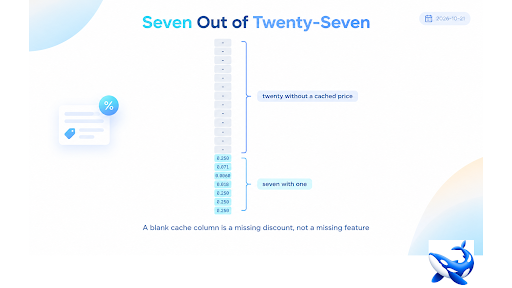
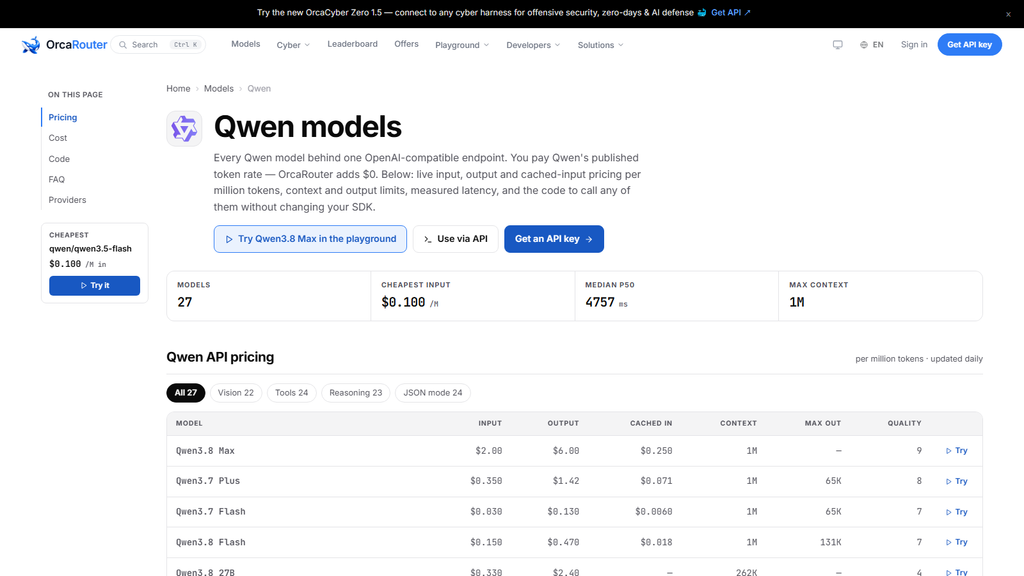
The OrcaRouter Qwen API page lists twenty-seven rows, and the cached-input column is empty on twenty of them [OURS page data, read 2026-10-21]. Seven rows carry a number.
The OrcaRouterQwen API page lists twenty-seven rows, and the cached-input column is empty on twenty of them [OURS page data, read 2026-10-21].
Seven rows carry a number. Twenty carry a dash. That is the highest blank rate in the cached column of any provider catalogue on the site — the Anthropic page fills all thirteen, the Z.ai page all ten, Kimi all four, DeepSeek ten of eleven — and it changes how a cost model has to be built for this provider, because on three quarters of the catalogue there is no discount rate to apply.
The seven that carry a price
Row
Input
Cached
Ratio
Qwen3.7 Flash
$0.030
$0.0060
20.0 %
Qwen3.7 Plus
$0.350
$0.071
20.3 %
Qwen3.8 Max
$2.00
$0.250
12.5 %
Qwen3.8 Max (0902)
$2.00
$0.250
12.5 %
Qwen3.7 Max
$1.25
$0.250
20.0 %
Qwen3.7 Max (2026-05-20)
$1.25
$0.250
20.0 %
Qwen3.8 Flash
$0.150
$0.018
12.0 %
Seven rows, and the ratios sort into two clusters rather than scattering: 12–12.5 percent on the three newest models (Qwen3.8 Max, 3.8 Max 0902, 3.8 Flash) and 20 percent on the 3.7 generation (3.7 Flash, 3.7 Plus, 3.7 Max and its dated twin).
That is a clean generational signal. The 3.8 family caches at about one eighth of input; the 3.7 family at about one fifth. If the trajectory continues, the discount is getting shallower with each generation — and a reader who took the 3.7 ratio as the catalogue’s cache policy would understate the bill on every 3.8 row.
There is a curiosity in the numbers too. Three separate rows — 3.8 Max, 3.8 Max (0902) and 3.7 Max and its dated twin — all cache at exactly $0.250, against three different input rates: $2.00, $2.00, $1.25 and $1.25. The cached price is flat across the family while the input rate is not, which is why the ratio differs between generations that share a cached figure.
What a blank cache column costs you
The practical question is what the twenty blanks mean for a bill, and the answer depends on a workload property that the table cannot see: how much of your request repeats.
Suppose a 50,000-token prefix on every call, ten thousand calls a month — half a billion input tokens that could in principle be cached.
On a row with a cached price, say Qwen3.7 Max at $1.25 input and $0.250 cached, those 500 million tokens bill at $125.00 if the prefix hits cache and $625.00 if it does not. The discount is worth $500 a month on this single shape [OURS arithmetic on VENDOR rates].
On one of the twenty rows with a dash, the same prefix bills at the full input rate. Qwen3.5-27B at $0.086 per million: 500 million tokens is $43.00 whether they repeat or not. Qwen3.8 27B at $0.330: $165.00. Qwen3 VL 235B A22B Instruct at $0.400: $200.00.
So the two effects — a cached price and a rate — compound. A row with a shallow discount at a very low rate can still be cheaper than a row with a deep discount at a high rate: Qwen3.5-27B’s uncached $43 beats Qwen3.7 Max’s cached $125 on this shape, because the input rate is fourteen times lower.
The blank column is therefore not a disadvantage in itself. It is a constraint on which of the two terms you get to use.
Why some rows are blank and others are not
The distribution of the seven is not random, and it points at something structural rather than at missing data entry.
Six of the seven are 3.7-generation or newer; one — Qwen3.8 Flash — sits with the 3.8 cluster. The twenty blanks are concentrated in the older generation, the open-weight size-variant rows (3.5-27B, 3.5-35B-A3B, 3.5-122B-A10B, 3.6 35B A3B) and the vision rows.
That is what a per-model cache capability looks like rather than a per-provider one. A catalogue that has a cache product for its flagship line and not for its size variants will produce exactly this column. The twenty dashes are then not an absence of information; they are information — those rows have no published cached rate, and a cost model that applies the flagship’s ratio to them is inventing a discount.
There is a second reading worth holding open. A dash could mean the row *does* support caching but the rate is not published here. The provider’s own documentation is the place that settles it, and until then the honest position is that neither reading is established — only that the table gives you nothing to compute with.
The context column, which has its own gaps
The same page’s context column is nearly complete by contrast: twenty-six of twenty-seven rows carry a value, and the single blank belongs to `Qwen3 VL 235B A22B Instruct`, whose max-output and quality cells are blank as well.
That row is the page’s only fully-empty structural row — three columns empty, only the two rates filled at $0.400 and $1.600 [VENDOR]. It is the row where a reader learns to distrust a line that has prices but no envelope, and it earns its place in any discussion of blank columns because it shows the two kinds of gap side by side: a cache rate that is missing on twenty rows, and an entire envelope missing on one.
The context distribution itself is worth noting because it is the widest of any provider catalogue: 1M on 15 rows, 262K on 4, 131K on 3, 32K on 4 [OURS]. The 32K rows are all in the 3.5 generation and every one of them carries an output ceiling of 65K — a ceiling twice the size of its own context window. That cannot happen in a real request: a response cannot exceed the window it shares with its prompt. The two figures must come from different sources, and a planner that takes whichever is larger and sizes chunks against it will send requests this row cannot serve.
The capability profile that decides the shortlist
One more column narrows the choice before price matters at all: Vision is 22 of 27 [OURS]. This is the vision-heavy catalogue of the provider set — the OpenAI page counts 59 of 76 and the Anthropic page 13 of 13, but for a mid-size catalogue a 22-of-27 vision rate is unusual and it makes multimodal work a first-class option rather than an add-on.
Tools sit at 24 of 27, reasoning at 23, JSON mode at 24. So five rows lack vision, four lack tools, and the overlap is small. In practice a multimodal workload can use almost the whole catalogue, which is the opposite of the Z.ai page where Vision is 2 of 10 and the price comparison is only meaningful within a two-row subset.
That breadth is what makes the blank cache column matter. Twenty rows with no discount is a smaller problem when the alternative is four eligible rows; here the choice is wide, and a cost model that ignores caching can still build a competitive shortlist from the twenty rows that have no cached rate.
How to model a catalogue with a mostly blank cache column
Three habits.
Do not carry the flagship’s ratio across the catalogue. The 12–20 percent range applies to seven rows. Extending it to the other twenty invents a discount that the table does not offer and understates the bill by up to a fifth of the input line.
Compare the uncached rate against other rows’ cached rate. Qwen3.5-27B at $0.086 uncached beats Qwen3.7 Max at $1.25 with a 20 percent cache ratio on any prefix-heavy shape. The column to compare is dollars per million tokens actually billed, not the discount percentage.
Treat a dash as a question for the provider’s documentation. It could mean no cache, or it could mean a cache with an unpublished rate. Neither reading is safe to assume; both are cheap to check.
Sourcing note: every rate, cached price, context window, max-output value and capability count in this article is read from the OrcaRouter Qwen provider page on 2026-10-21. The rates are the provider’s published prices passed through with $0 markup [VENDOR]; the row structure, the blank-column counts, the ratio arithmetic and the monthly figures are ours [OURS]. The 0-to-10 quality scores, where mentioned, are our own composite, not a third-party benchmark. No third-party evaluation figures are used. Rates change; all values checked 2026-10-21.