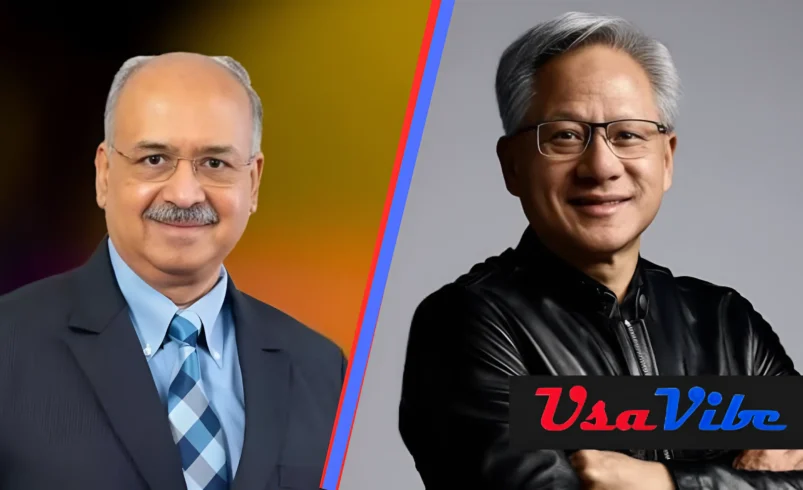
The names Dilip Shanghvi and Jensen Huang come from two very different corners of the business world. One built his reputation in pharmaceuticals, helping transform a small Indian drug company into a global healthcare business. The other became one of the defining figures in modern computing after co-founding NVIDIA and helping move graphics processors from a specialized technology into the center of artificial intelligence.
At first glance, there may not appear to be much connecting the two. Pharmaceuticals and semiconductors operate in different markets, serve different customers, and require very different forms of technical expertise. Yet the careers of Dilip Shanghvi and Jensen Huang reveal several broader themes in entrepreneurship: patience, long-term investment, technological change, strategic acquisitions, and the ability to build around a product category before it becomes globally dominant.
Shanghvi is the founder and Executive Chairman of Sun Pharmaceutical Industries, while Huang remains NVIDIA’s founder, President and Chief Executive Officer. Their companies became influential for different reasons, but both leaders remained closely associated with the businesses they helped create.
Their stories are therefore less about following a single formula for success and more about understanding how two entrepreneurs navigated industries that changed dramatically during their careers.
Dilip Shanghvi: From Pharmaceutical Trading to Global Healthcare
Dilip Shanghvi’s business journey began in India during a period when the country’s pharmaceutical industry was developing rapidly.
Born in 1955, Shanghvi grew up in Kolkata and studied commerce at the University of Calcutta. His early exposure to pharmaceuticals came through his family. His father was involved in the wholesale distribution of medicines, giving Shanghvi an opportunity to observe the industry from close range.
That experience eventually influenced an important decision.
Rather than remaining exclusively within pharmaceutical distribution, Shanghvi wanted to enter manufacturing. In 1983, he founded Sun Pharmaceutical Industries with a relatively small starting operation focused on medicines, including psychiatric treatments.
The company was not initially the global pharmaceutical giant that it would later become.
Its growth developed gradually through a combination of manufacturing, product expansion, international business and acquisitions.
That gradual approach became an important characteristic of Shanghvi’s career.
Instead of relying on a single dramatic breakthrough, Sun Pharma expanded across different therapeutic areas and markets. Over time, the business became one of India’s most important pharmaceutical companies.
Today, Shanghvi serves as Executive Chairman of Sun Pharmaceutical Industries and is also associated with Sun Pharma Advanced Research Company.
His career has also extended beyond the company’s day-to-day commercial operations. He has held positions connected with industry organizations, education, research and economic development, and received the Padma Shri from the Government of India in 2016.
The Sun Pharma Story
Understanding Dilip Shanghvi requires understanding Sun Pharma.
The company grew from a relatively small pharmaceutical business into a multinational organization with operations extending far beyond India.
One of the most significant elements of this expansion was the company’s use of acquisitions.
Sun Pharma did not simply depend on organic growth. It used acquisitions to enter new markets, strengthen its product portfolio and increase its international presence.
Among the most notable transactions was the acquisition of Ranbaxy Laboratories, announced in 2014. The deal was valued at approximately $4 billion and represented a major step in Sun Pharma’s international expansion.
Such transactions also brought complexity.
Large pharmaceutical acquisitions involve regulatory issues, manufacturing systems, product portfolios, employees and international operations. Integrating a major company requires considerably more than simply completing a financial transaction.
For Shanghvi, this became part of a much larger business strategy.
The objective was not merely to make Sun Pharma larger. The company was being developed into a broader pharmaceutical organization with a presence across multiple markets.
That approach helped establish Shanghvi as one of India’s best-known business entrepreneurs.
Jensen Huang: Building NVIDIA Before AI Became Mainstream
Jensen Huang’s story begins in a completely different industry.
Born in Taiwan in 1963, Huang spent part of his childhood in Taiwan and Thailand before moving to the United States. He eventually studied electrical engineering at Oregon State University and completed a master’s degree at Stanford University.
Before founding NVIDIA, Huang worked at LSI Logic and Advanced Micro Devices.
Those experiences placed him directly inside the semiconductor industry.
In 1993, Huang co-founded NVIDIA with Chris Malachowsky and Curtis Priem. He became the company’s President and CEO and has remained in that position since its founding.
At the time, there was no obvious indication that NVIDIA would eventually become one of the world’s most important technology companies.
The company initially focused heavily on graphics and accelerated computing.
That focus became increasingly significant as computing requirements changed.
The development of NVIDIA’s GPU technology helped transform computer graphics, particularly in gaming. But the same parallel-processing capabilities that made GPUs valuable for graphics eventually proved extremely useful for scientific computing, machine learning and artificial intelligence.
That transition changed NVIDIA’s trajectory.
From Graphics to Artificial Intelligence
The most important part of Jensen Huang’s business story may not be the creation of a graphics-chip company itself.
It is the decision to continue investing in GPU-based accelerated computing as its applications expanded.
For years, graphics processing was primarily associated with gaming and visual computing. But researchers discovered that GPUs could perform certain mathematical operations extremely efficiently.
That created an opportunity far beyond video games.
Machine learning and deep learning workloads increasingly benefited from GPU acceleration. As artificial intelligence developed, NVIDIA’s hardware and software ecosystem became increasingly important to researchers, developers and technology companies.
The company’s CUDA platform also became an important part of that ecosystem, giving developers tools for using NVIDIA GPUs for general-purpose computing.
By the time generative AI became a mainstream technology, NVIDIA was already positioned inside a computing architecture that many AI systems depended upon.
This is a major reason Jensen Huang became such a prominent figure in the technology industry.
His company was not created specifically for the generative AI boom. NVIDIA had spent decades building technology that later became highly relevant to it.
What Connects Dilip Shanghvi and Jensen Huang?
Although their industries are dramatically different, several aspects of the two careers are surprisingly similar.
Both entrepreneurs entered markets where long-term development mattered.
Pharmaceutical research can take years before products reach patients. Semiconductor technology also requires enormous investment in research, design, manufacturing partnerships and software ecosystems.
Neither industry rewards short-term thinking alone.
Both leaders also built businesses around technological or structural changes that took years to fully develop.
For Shanghvi, the opportunity was the expansion and globalization of India’s pharmaceutical industry.
For Huang, the opportunity was the transition toward increasingly accelerated computing.
In both cases, the companies became larger because their leaders continued expanding the original business model.
Different Industries, Similar Long-Term Thinking
Pharmaceutical companies operate under extensive regulatory requirements.
They must deal with clinical development, manufacturing standards, intellectual property, regulatory approvals, distribution networks and changing healthcare needs.
Semiconductor companies face another collection of challenges.
They must deal with chip architecture, engineering talent, fabrication partnerships, supply chains, software, data centers and rapidly changing computing requirements.
Yet both environments punish companies that stop evolving.
A pharmaceutical company cannot depend forever on one generation of products.
A technology company cannot assume that today’s hardware architecture will remain dominant indefinitely.
Shanghvi and Huang therefore represent two versions of the same broader entrepreneurial challenge: building an organization capable of changing without abandoning its central identity.
Dilip Shanghvi’s Approach to Growth
Shanghvi’s career is closely associated with incremental expansion.
Sun Pharma grew through product development, international expansion and acquisitions.
This strategy allowed the company to move from its original Indian base toward a much broader international footprint.
The acquisition of Ranbaxy became a particularly important example of this approach.
Rather than attempting to build every capability internally, Sun Pharma could acquire businesses, products and market access that would take many years to develop independently.
However, acquisitions also create risks.
A larger company is not automatically a better company. Integration can create financial, operational and cultural challenges.
The ability to manage those complications is therefore an important part of Shanghvi’s business story.
Jensen Huang’s Approach to Long-Term Technology
Huang’s strategy looks different because NVIDIA operates in a technology market where product cycles can move extremely quickly.
The company’s success depended not only on producing powerful chips but also on building an ecosystem around them.
Hardware alone does not explain NVIDIA’s modern position.
Developers need software tools. Researchers need frameworks. Companies need infrastructure. Data centers need networking and computing systems.
NVIDIA therefore expanded beyond the traditional idea of a graphics-chip company.
Its business increasingly became connected with accelerated computing, data centers, artificial intelligence, networking and large-scale computing infrastructure.
This ecosystem approach became particularly important as AI workloads expanded.
The Importance of Timing
Timing is another major theme connecting the careers of Dilip Shanghvi and Jensen Huang.
When Shanghvi began building Sun Pharma, India’s pharmaceutical market had substantial room for expansion.
When Huang founded NVIDIA in 1993, computer graphics were becoming increasingly important to personal computing and gaming.
Neither entrepreneur could have known exactly how their industries would evolve decades later.
That is an important distinction.
Successful businesses are often described retrospectively as though their eventual outcomes were obvious.
They rarely are.
At the beginning, entrepreneurs generally operate with incomplete information. They make investments based on the opportunities they can identify at the time.
Shanghvi could not know exactly how large Sun Pharma would become.
Huang could not know that GPUs would eventually become central to the AI infrastructure economy.
Their careers demonstrate how long-term positioning can sometimes become more valuable as technology and markets evolve.
Education and Early Professional Experience
The educational backgrounds of the two entrepreneurs also reflect their different industries.
Shanghvi studied commerce at the University of Calcutta.
His early professional environment was closely connected to pharmaceutical distribution and business operations.
Huang studied electrical engineering.
His education was directly connected to the technical world in which he would eventually build NVIDIA.
Huang’s engineering background became particularly relevant as NVIDIA developed increasingly sophisticated semiconductor architectures.
Shanghvi’s commercial background, meanwhile, became important in navigating business strategy, acquisitions, international markets and corporate development.
Neither career can be reduced to education alone.
But both illustrate how early experiences can provide a foundation for later entrepreneurship.
Their Relationship With Innovation
Innovation means different things in pharmaceuticals and computing.
In pharmaceuticals, innovation may involve discovering new medicines, improving drug delivery, developing new formulations or expanding treatments into new therapeutic areas.
In computing, innovation may involve semiconductor architecture, software platforms, networking technologies or new approaches to processing information.
Shanghvi’s career is therefore closely associated with pharmaceutical commercialization and expansion.
Huang’s career is strongly associated with technological infrastructure.
Both demonstrate that innovation is not limited to inventing a single product.
It can also involve creating organizations capable of repeatedly developing, acquiring or commercializing new capabilities.
Leadership Beyond the Companies
Both men have also developed public profiles that extend beyond their executive positions.
Shanghvi has participated in industry, educational and public institutions. He has served in leadership roles connected with pharmaceutical organizations and educational bodies and has been involved with initiatives related to economic development.
Huang has become a highly visible figure in technology.
His public appearances frequently focus on computing, artificial intelligence, semiconductors and the future of technology.
NVIDIA’s rise has made Huang one of the most recognizable executives in the global technology sector.
Their public identities therefore reflect the growing influence of the industries they represent.
Jensen Huang and the AI Era
Huang’s prominence increased dramatically as artificial intelligence became one of the defining technological developments of the 2020s.
NVIDIA’s GPUs became central components in many large-scale AI computing systems.
The company’s technology is used across research institutions, cloud providers, technology companies and other organizations developing AI systems.
That position also created new challenges.
The semiconductor industry has become strategically important to governments because advanced computing is increasingly connected with economic competitiveness, national security and scientific research.
As a result, Huang has increasingly appeared in conversations that extend beyond traditional technology discussions.
His comments about AI development, computing infrastructure and semiconductor policy are now followed around the world.
This represents a major transformation from NVIDIA’s early identity as a graphics-focused company.
Dilip Shanghvi and the Global Pharmaceutical Industry
Shanghvi’s influence is similarly tied to a broader transformation.
Indian pharmaceutical companies became increasingly important in global medicine, particularly in generic medicines and international pharmaceutical supply.
Sun Pharma’s growth helped establish the company as a major global pharmaceutical player.
The company’s expansion also demonstrated how Indian businesses could compete internationally through manufacturing capabilities, acquisitions, research and commercial strategy.
Shanghvi’s story is therefore not only about personal wealth or entrepreneurship.
It is also part of the broader story of India’s emergence as an important force in the international pharmaceutical market.
Net Worth and Public Wealth Estimates
Searches for both Dilip Shanghvi and Jensen Huang frequently lead to questions about their net worth.
These figures should be treated as estimates rather than fixed personal balances.
Forbes’ September 2026 profile placed Huang’s estimated real-time wealth at approximately $187 billion, while its September 2026 profile for Shanghvi placed his estimated wealth at approximately $26.4 billion.
These figures can change substantially because much of billionaire wealth is connected to ownership of publicly traded companies and other assets.
A change in a company’s share price can therefore alter an individual’s estimated net worth without any corresponding cash transaction.
For that reason, wealth rankings should be understood as snapshots rather than permanent measurements.
Family and Privacy
Both entrepreneurs have families, but their public profiles differ significantly from celebrity culture.
Shanghvi has generally maintained a relatively private personal life despite his enormous business profile. Public business records identify family members who have become involved in the broader business organization.
Huang is also publicly recognizable, but much of the available information about him centers on his professional career, NVIDIA and technology.
For both men, the most reliable public record is therefore primarily professional rather than personal.
That distinction matters when discussing prominent business figures.
A large number of websites publish detailed claims about executives’ homes, spending habits, relationships and personal routines. Such information is not always equally reliable.
The strongest biographies tend to focus on documented professional milestones rather than speculation.
Two Entrepreneurs, Two Different Definitions of Scale
The word “scale” means something different in the two stories.
For Sun Pharma, scale means manufacturing medicines, entering international markets, expanding therapeutic portfolios and managing a global pharmaceutical organization.
For NVIDIA, scale means designing computing platforms capable of supporting enormous amounts of data processing across data centers, research institutions and AI systems.
Both forms of scale require infrastructure.
Neither company could have become globally significant through personal branding alone.
The businesses had to develop systems capable of operating at international levels.
That is perhaps one of the clearest lessons from comparing Dilip Shanghvi and Jensen Huang.
Entrepreneurship may begin with an individual, but major companies eventually depend on organizations, teams, technology, capital and processes that extend far beyond the founder.
The Role of Risk
Both careers also involved substantial risk.
Launching a pharmaceutical manufacturing company requires capital and market knowledge.
Building a semiconductor company in the early 1990s required technological confidence at a time when the future direction of computing was uncertain.
The risks were different, but the underlying challenge was similar.
The entrepreneur has to commit resources before the future becomes obvious.
That means accepting uncertainty.
Shanghvi’s expansion strategy involved acquisitions that carried integration and financial risks.
Huang’s continued investment in GPU computing involved technological and market risks.
In retrospect, those decisions can appear inevitable because the companies eventually became successful.
At the time, however, the outcomes were not guaranteed.
Why Their Stories Continue to Attract Attention
The interest surrounding Dilip Shanghvi and Jensen Huang is partly explained by their wealth, but wealth alone does not explain their continued relevance.
Both represent industries that affect everyday life.
Pharmaceuticals influence healthcare and access to medicine.
Semiconductors influence computers, smartphones, data centers, automobiles and increasingly artificial intelligence.
Their companies therefore operate behind technologies and products that millions of people encounter without necessarily thinking about the businesses behind them.
That gives their stories a significance beyond conventional billionaire profiles.
They are also examples of entrepreneurs who remained closely associated with the companies they founded.
Huang has led NVIDIA since 1993.
Shanghvi continues to serve in a senior leadership role at Sun Pharma decades after founding the company.
That continuity is unusual among major global corporations.
What the Two Careers Reveal About Business Building
There is no single formula connecting Sun Pharma and NVIDIA.
Their industries are too different for that.
But several broad ideas emerge.
First, both businesses were built over decades rather than overnight.
Second, both companies adapted as their markets changed.
Third, both founders remained deeply involved in strategic direction.
Fourth, neither company’s modern identity is identical to its original identity.
Sun Pharma expanded from its early pharmaceutical operations into a multinational healthcare business.
NVIDIA evolved from a graphics-focused semiconductor company into a major accelerated-computing and AI infrastructure company.
That evolution may be the most important similarity of all.
Successful organizations often survive because they change.
Dilip Shanghvi and Jensen Huang in 2026
As of 2026, both entrepreneurs remain connected to the companies that define their careers.
Dilip Shanghvi serves as Executive Chairman of Sun Pharmaceutical Industries.
Jensen Huang continues as NVIDIA’s Founder, President and Chief Executive Officer.
Their companies now operate at global scale, but the nature of their challenges has changed.
Sun Pharma continues to navigate pharmaceutical research, regulation, international competition and healthcare markets.
NVIDIA operates within an intensely competitive semiconductor and AI ecosystem where demand, supply chains, computing architectures and geopolitical conditions can change rapidly.
The next chapters of both stories will therefore involve the same basic challenge that shaped their careers from the beginning: adapting to a future that cannot be predicted with complete certainty.
Final Perspective on Dilip Shanghvi and Jensen Huang
Dilip Shanghvi and Jensen Huang built their reputations in industries that appear completely unrelated.
One became associated with medicines and pharmaceuticals.
The other became associated with GPUs, accelerated computing and artificial intelligence.
Yet looking at their careers side by side reveals an important common theme.
Neither story is simply about becoming wealthy.
Both are stories about building companies that survived long enough to benefit from major changes in their industries.
Shanghvi helped transform Sun Pharma from a small pharmaceutical enterprise into a global healthcare company.
Huang helped transform NVIDIA from a graphics technology company into one of the central computing businesses of the AI era.
Their journeys took different routes, but both demonstrate the importance of long-term thinking, adaptation and organizational scale.
Perhaps the most interesting part of the comparison is that neither entrepreneur started with the industry position they hold today.
Their companies evolved.
Their markets evolved.
Technology evolved.
And their leadership evolved with them.
That is what makes Dilip Shanghvi and Jensen Huang such an interesting pairing. Their stories show two very different ways a founder can remain relevant for decades while the world around the company changes dramatically.
Frequently Asked Questions
Who is Dilip Shanghvi?
Dilip Shanghvi is an Indian entrepreneur and the founder of Sun Pharmaceutical Industries. He currently serves as the company’s Executive Chairman and has played a major role in its international expansion.
Who is Jensen Huang?
Jensen Huang is the founder, President and CEO of NVIDIA. He co-founded the company in 1993 and has remained its chief executive since its establishment.
What companies are Dilip Shanghvi and Jensen Huang associated with?
Dilip Shanghvi is primarily associated with Sun Pharmaceutical Industries and Sun Pharma Advanced Research Company. Jensen Huang is primarily associated with NVIDIA.
Are Dilip Shanghvi and Jensen Huang in the same industry?
No. Shanghvi built his career in pharmaceuticals and healthcare, while Huang built his career in semiconductors, computing and artificial intelligence.
What is Jensen Huang known for?
Jensen Huang is best known for co-founding NVIDIA and leading the company through its transformation from a graphics-focused technology business into a major provider of accelerated computing and AI infrastructure.
What is Dilip Shanghvi known for?
Dilip Shanghvi is best known for founding Sun Pharmaceutical Industries and helping expand it into a major international pharmaceutical company.
How did NVIDIA become connected with artificial intelligence?
NVIDIA’s GPUs were originally strongly associated with computer graphics, but their parallel-processing capabilities also made them useful for machine learning and other computational workloads. Over time, NVIDIA developed hardware and software ecosystems that became increasingly important to AI development.
Did Sun Pharma grow through acquisitions?
Yes. Acquisitions have played an important role in Sun Pharma’s expansion. One of the most notable was its 2014 acquisition of Ranbaxy Laboratories.
Are Dilip Shanghvi and Jensen Huang billionaires?
Both have been publicly estimated as billionaires. Their estimated net worth changes over time because a significant portion of their wealth is connected to company ownership and market valuations.
What is the main similarity between Dilip Shanghvi and Jensen Huang?
One major similarity is their long-term involvement in companies they helped build. Both developed businesses that evolved significantly beyond their original markets and became internationally important within their respective industries.
Read More: Usa Vibe